


You took the offer. The number on the letter — $50,000 — felt solid. Then you opened a rent listing in Short North and the number didn’t feel quite as solid anymore.
Here’s the thing: a budget in Columbus, Ohio on a 50K salary in 2026 absolutely works. But it works differently than it did even two years ago. Rents have climbed roughly 13% year-over-year on one-bedrooms, groceries are still annoyingly stubborn, and the 2.5% Columbus city income tax quietly trims your paycheck before you even see it.
This isn’t a fantasy budget written by someone who hasn’t paid a utility bill since 2018. This is a real, line-by-line monthly breakdown that accounts for what actually leaves your account — and what’s left to save, invest, or spend on a Saturday at North Market.
By the end of this guide, you’ll know your true take-home, what each category should cost, where most newcomers overspend, and how to leave room for a life — not just survival. Let’s get into the numbers.
What a Budget in Columbus on a 50K Salary Really Looks Like After Taxes
Before we touch rent, let’s deal with the elephant: you don’t actually get to spend $50,000. You get to spend what’s left after the federal government, FICA, Ohio, and the City of Columbus each take their slice.
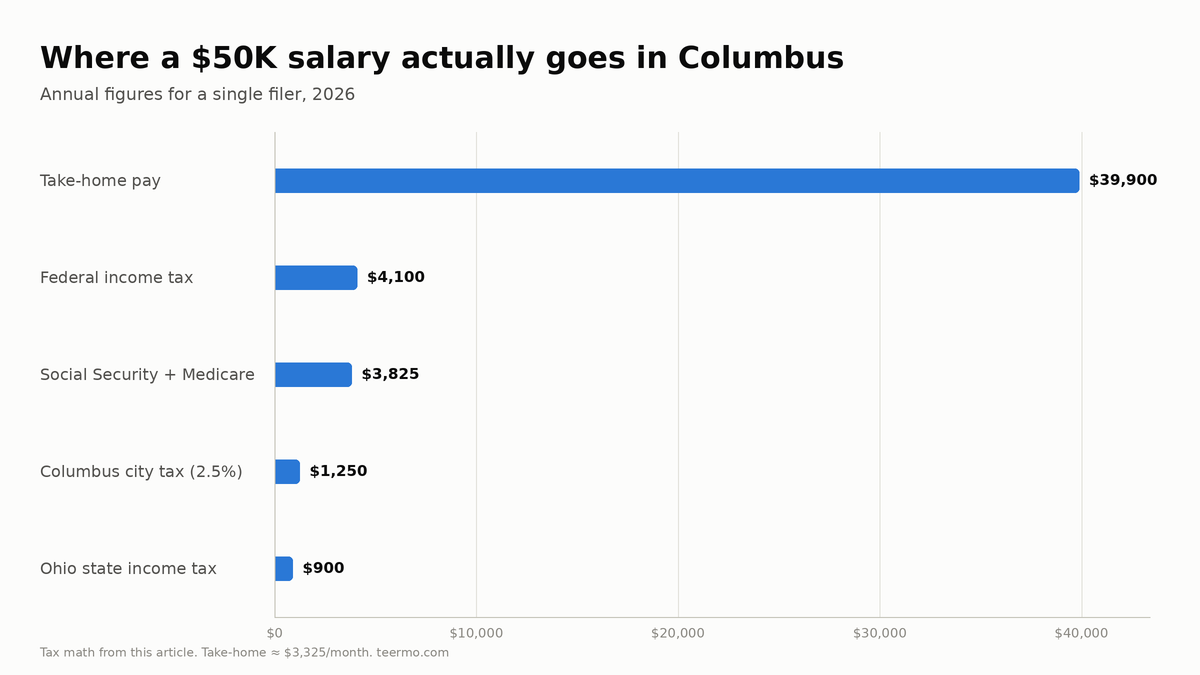
Here’s the honest math for a single filer in 2026:
- Federal income tax: roughly $4,100
- Social Security + Medicare (FICA): $3,825
- Ohio state income tax: about $900
- Columbus city tax (2.5%): $1,250
- Take-home: approximately $39,900/year — or $3,325/month
That $3,325 is your real number. Every budget recommendation in this article works from that figure, not from $4,166 (the pre-tax monthly).
If your employer offers a 401(k) match, contributing up to the match reduces your taxable income and gets you free money. A 5% contribution would lower your take-home to around $3,100/month — and we’ll plan for that scenario too, because most personal finance experts would slap me for skipping it.
Quick reality check: the median household income in Ohio is just under $60,000, so a 50K salary in Columbus puts you within reach of a comfortable, not lavish, life — provided your budget is set up right.
Rent Budget Columbus: Where Most of Your Paycheck Actually Goes
Rent is going to be your single biggest line item. Pretending otherwise is how people end up house-poor at twenty-five.
The classic rule says spend no more than 30% of gross income on rent. On a 50K salary, that’s $1,250/month. The problem? That number now lines up almost exactly with the average one-bedroom in Columbus, which currently sits between roughly $1,077 and $1,200 depending on which data source you trust (RentCafe market data).
So you have three realistic plays:
Play 1 — Solo in an affordable neighborhood. Aim for $850–$1,050/month. Forest Park East, Old North Columbus, Franklinton, Westland, and Whitehall all have one-bedrooms well below the city average. Trade-offs: longer commutes, fewer walkable amenities, sometimes older buildings.
Play 2 — Roommate in a desirable area. Split a two-bedroom in the University District, Clintonville, or Italian Village. Your share lands around $700–$900, freeing up serious money for everything else.
Play 3 — Solo in the trendy zip codes. Short North, Downtown, German Village, Grandview. Expect $1,400–$1,800. On 50K, this only works if you cut hard elsewhere — usually meaning no car, minimal eating out, no real savings.
“I moved to Columbus thinking I’d live downtown. Three months in, I realized my one-bedroom in the Short North was eating 45% of my take-home. I broke the lease, found a place in Clintonville, and suddenly had $400 extra a month.” — story I heard from a coworker who learned the hard way.
Recommended target for this budget: $1,000/month for rent, which keeps you at roughly 30% of take-home rather than 30% of gross. That distinction matters more than people realize.
Utilities and Groceries Columbus: The Quiet Budget Killers
These two categories are where almost every new Columbus resident bleeds money without realizing it. They’re small enough to ignore individually and large enough to wreck a budget collectively.
Utilities — expect around $180–$230/month:
- Electric (AEP Ohio): $70–$110 depending on season. Summer AC and winter heat both push this up.
- Gas (Columbia Gas): $40–$80, with brutal January spikes.
- Water/sewer/trash: $50–$70, billed quarterly in many buildings.
- Internet: $50–$70 for solid speeds with Spectrum or AT&T Fiber.
A lot of apartments include water and trash in rent, so always ask — that single detail can shift your monthly utilities and groceries Columbus math by $60.
Groceries — budget $300–$400/month for one person:
Ohio sits about 1% above the national grocery average, which is essentially neutral. The real variable is where you shop. Kroger and Meijer give you mainstream prices, Aldi cuts your bill roughly 25%, and Trader Joe’s sits in the middle for specialty items. Hitting the North Market on Saturdays is a joy but treat it as entertainment spending, not groceries.
Pro move: plan two grocery runs per month, not weekly. People who shop weekly average 18% higher food spend, mostly because every “quick stop” turns into $40 of impulse items. Ever wondered why that bag of chips somehow always ends up in your cart? Same reason.
Combined utilities + groceries target: $550/month.
Transportation, Insurance, and Healthcare on a Columbus Budget
Columbus is a car city. The COTA bus system covers a lot of ground, but unless you live and work along the same corridor, you’ll likely need a vehicle. That’s where a lot of out-of-state transplants get caught off guard.
Realistic transportation costs:
- Car payment (used, financed): $250–$350. If you own outright, congratulations — redirect this to savings.
- Auto insurance in Ohio: $90–$140/month for a clean record. Ohio averages well below coastal states.
- Gas: $90–$120 with current pump prices and average commute miles.
- Maintenance/parking sinking fund: $40.
Subtotal: roughly $400–$500/month for car ownership. If you can pull off a no-car lifestyle in the urban core, you’d save around $5,000 a year. Few people actually do it long-term in Columbus, but it’s worth considering.
Health insurance: If your employer covers most of your premium, you’re probably paying $80–$200 monthly for solo coverage. Marketplace plans without subsidy run higher — often $350+. Bake this in honestly.
Phone: $40–$70 if you’re not still on a family plan. (No judgment if you are.)
Add these together and transportation + insurance + phone realistically runs $550–$700/month. For our model budget, we’ll use $600.
The Full Monthly Budget Breakdown (Copy This Template)
Here’s the entire picture pulled together. This is built on a $3,325/month take-home and assumes you’re a single renter with a modest car. Adjust to fit your reality.
| Category | Monthly Amount | % of Take-Home |
|---|---|---|
| Rent | $1,000 | 30% |
| Utilities + Internet | $200 | 6% |
| Groceries | $350 | 10.5% |
| Transportation (car, gas, insurance) | $500 | 15% |
| Health insurance + phone | $200 | 6% |
| Dining out + entertainment | $250 | 7.5% |
| Personal (clothing, haircuts, gym, subscriptions) | $150 | 4.5% |
| Savings (emergency fund + Roth IRA) | $400 | 12% |
| Buffer / sinking funds / surprises | $275 | 8.5% |
| Total | $3,325 | 100% |
A few notes on this template:
The savings line is non-negotiable. $400/month builds a $5,000 emergency fund in about a year — your single most important financial milestone in your twenties. After that, redirect part of it to a Roth IRA. According to the Bureau of Labor Statistics consumer expenditure data, the average American at this income level saves under 5% — beating that bar is genuinely meaningful.
The buffer line saves your sanity. Car repair, birthday gifts, the surprise wedding invitation, the dentist who finds a cavity. Without this line, every “unexpected” expense becomes a credit card balance.
The dining-out line is realistic, not aspirational. $250 in Columbus gets you two nicer dinners and a handful of casual lunches per month. The food scene here is genuinely good — don’t budget yourself into never enjoying it.
5 Budget Mistakes That Wreck a 50K Salary in Columbus
Before you finalize anything, here are the traps. I’ve watched smart people fall into every one of these.
1. Treating “30% of gross” as the rent ceiling. Thirty percent of gross ignores taxes entirely. Use 30% of take-home instead. The difference is roughly $200/month — enough to fund your entire savings line.
2. Skipping renter’s insurance. It costs $12–$18/month and protects against fire, theft, and liability claims. Skipping it to save $15 is the most expensive frugality decision you can make.
3. Underestimating Columbus winter utility bills. January gas bills can hit $150 in older apartments with mediocre insulation. Build for the worst month, not the average.
4. Buying a car you can’t actually afford. A $500/month car payment on a 50K salary in Columbus is the most common reason young professionals end the month at zero. Used reliable beats new-and-shiny every single time at this income.
5. Lifestyle creep from happy hours. Two $25 happy hours a week is $200/month — almost your entire savings line. Set a number, track it for one month, and you’ll see exactly where the money goes.
Final Thoughts
Columbus on $50,000 is not a city you survive — it’s a city you live in. The numbers above aren’t aspirational; they’re the actual shape of a working budget for Columbus on a 50K salary in 2026, and thousands of people in this city run some version of them every month.
What changes the outcome isn’t the salary. It’s whether you set up the system before the first paycheck hits or after the first overdraft does. The people who do this well usually share three things: they pick rent deliberately rather than emotionally, they automate the $400 savings transfer the same day they get paid, and they track spending for the first 90 days even if they hate spreadsheets.
You don’t need to become a personal finance influencer. You just need a structure that makes sense, a buffer that absorbs surprises, and a small, consistent savings habit. Do those three things and a 50K salary in Columbus will feel like more than enough — because mathematically, it is.
Pick one move today: open the rent listings in two affordable neighborhoods, or set up an automatic $100 transfer to savings on your next payday. Small step. Start now.
Frequently Asked Questions
Q: Is $50,000 a livable salary in Columbus in 2026?
A: Yes, comfortably, for a single person willing to live outside the trendiest neighborhoods. Your take-home lands around $3,325/month after federal, state, FICA, and the 2.5% Columbus city tax. With rent at $1,000 and disciplined spending, you can save 10–12% of income and still enjoy the city.
Q: How much should I budget for rent on a 50K salary in Columbus?
A: Target $900–$1,050/month, which is around 30% of your take-home pay, not your gross. Affordable neighborhoods like Old North Columbus, Forest Park East, Whitehall, and Franklinton consistently have one-bedrooms in this range. Going above $1,200 starts squeezing everything else.
Q: What’s the biggest hidden cost when moving to Columbus on a moderate salary?
A: The 2.5% Columbus city income tax catches almost every transplant off guard, especially people coming from states or cities without local income taxes. On 50K, it’s roughly $1,250 per year — about $100/month that disappears before you ever see it. Always factor it into your budget math from day one.
