


The average student loan borrower spends years — often decades — paying for a decision made at seventeen. That’s the quiet part of the college conversation: the debt outlives the dorm memories by a long, long time.
So here’s the question families should ask before “which college?”: is it actually possible to pay for college without loans in 2026?
Honest answer: yes, for far more students than currently do it — but almost never through one magic source. Debt-free degrees are built from a stack: free money first, cheap credits second, earned money third, and a price tag chosen to match. This guide walks the full stack in order, with the real trade-offs of each layer.
The No-Loan Mindset: Price Is a Choice, Not a Given
Sticker prices make headlines; almost nobody pays them. The real number that matters is your net price — what a specific college costs your specific family after grants and scholarships. Every college is required to publish a net price calculator; fifteen minutes there beats hours of brochure reading.
The single biggest no-loan decision is choosing a school whose net price fits your family’s actual cash flow. A $6,000-a-year gap is closeable with work and savings. A $25,000 gap becomes loans, no matter how disciplined you are.
Keep that lens as we stack the layers below.
Pay for College Without Loans: Stack These Layers in Order
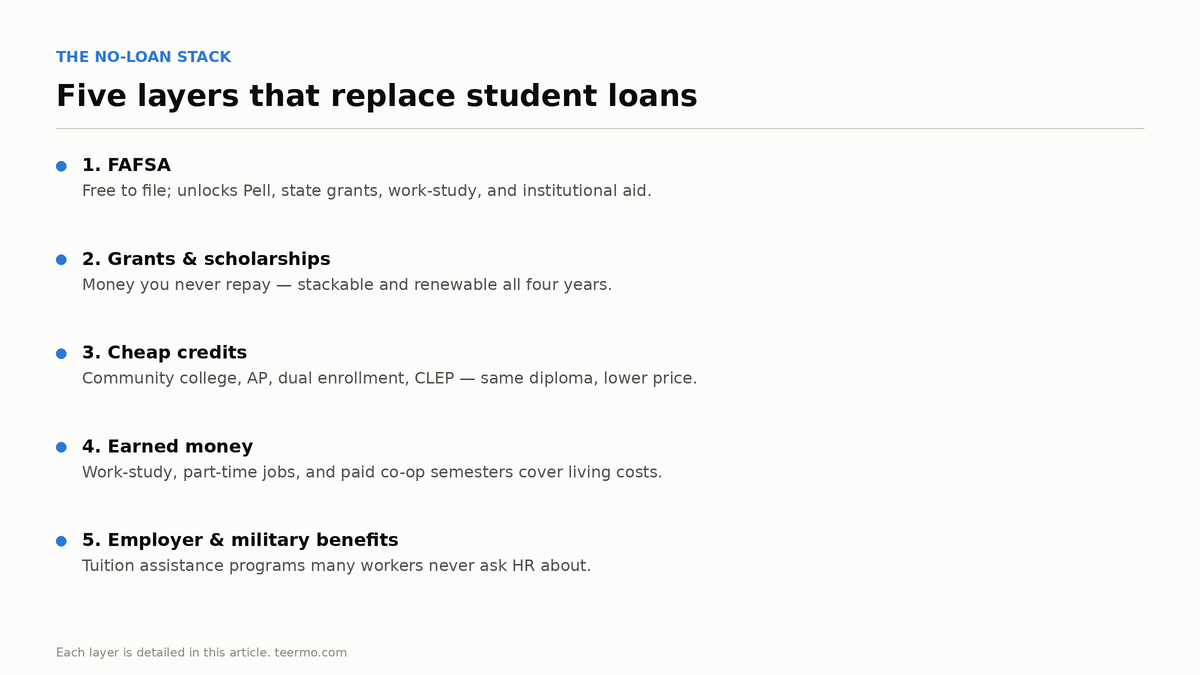
Layer 1: The FAFSA — File It Even If You Think You Won’t Qualify
The FAFSA at studentaid.gov is the gate to federal Pell Grants, state grants, work-study, and most institutional need-based aid. It’s free, it opens in the fall for the following school year, and some aid genuinely runs out — file early.
Families routinely skip it assuming they earn too much, then miss state programs and institutional grants with much higher income cutoffs than they guessed. Rule: everyone files, every year.
Layer 2: Grants and Scholarships — the Money You Never Repay
Grants come from need (federal Pell, state programs, the college itself); scholarships come from merit, identity, location, and field of study. Both are stackable, and both renew — meaning one good application season can fund four years.
We wrote a full playbook on how to find scholarships — the short version: local first, national last, and treat it like a part-time job for one season. The hourly rate beats any campus job.
Layer 3: Cheap Credits — Community College, AP, and Dual Enrollment
Two years at a community college followed by a transfer to a four-year university produces the same diploma with dramatically lower total cost — often the single largest saving available. Check your state’s guaranteed-transfer agreements before enrolling so every credit counts.
Still in high school? AP scores, dual-enrollment classes, and CLEP exams convert into college credits for a fraction of tuition. Every credit you bring with you is a credit you never pay full price for.
Layer 4: Earned Money — Work-Study, Part-Time Work, and Co-ops
Federal work-study (unlocked by the FAFSA) provides on-campus jobs designed around class schedules. A standard part-time job covering 10–15 hours a week can realistically contribute several hundred dollars a month toward living costs — the category that quietly generates most “extra” borrowing.
Co-op programs alternate paid full-time work semesters with study semesters; they extend graduation slightly and shrink costs substantially, with a résumé bonus at the end. For flexible earning ideas that fit around classes, see our list of side hustles that pay $1,000 a month.
Layer 5: Employer and Military Benefits
A growing list of large employers offers tuition assistance to part-time employees — some covering full tuition at partner schools. If you’re already working, ask HR before you enroll anywhere. Military paths (GI Bill, ROTC, National Guard tuition programs) remain the most comprehensive education funding that exists, for those genuinely suited to the commitment.
Put It Together: What a Debt-Free Path Actually Looks Like
Meet a realistic example: Sofia’s family can spare $250 a month. Her stack: state grant plus a Pell partial from filing FAFSA early; $3,750 in local scholarships from one application season; two years at community college while living at home; a 12-hour campus job; transfer to the state university for years three and four.
Total borrowed: zero. Was it the postcard college experience for all four years? No. Was she free at 22 while classmates budgeted around loan payments? Completely.
Debt-free college is rarely one big win — it’s five medium wins stacked on a realistic price. Any two layers alone usually aren’t enough; the stack is the strategy.
The Trade-Offs Nobody Should Hide From You
Fairness requires the other side. The no-loan path often means a less famous school, living at home some years, working while studying, and saying no to the “dream school” whose net price doesn’t fit. For a handful of career paths, a specific institution’s network genuinely matters — and a modest, strategic loan can be a rational choice.
What’s never rational is the default path: maximum borrowing for an unexamined price. If you do borrow, borrow last (after every layer above), borrow federal (protections matter), and borrow for tuition — not lifestyle.
Ask yourself the uncomfortable question early: would I choose this school if I had to pay its gap in cash? If the answer is no, the loan doesn’t change the answer — it postpones it.
Your 90-Day Action Plan
- This week: run net price calculators for five schools, including one community college path.
- This month: file the FAFSA, build the scholarship spreadsheet, ask HR (yours or your parents’) about tuition benefits.
- Next 60 days: submit local scholarship applications, map transfer agreements if going the community-college route, apply for work-study or campus jobs.
- Ongoing: reapply for scholarships every year — most students stop after freshman year, which is exactly why sophomores win them.
Final Thoughts: The Degree Is the Goal — Not the Debt
Nobody hands out awards for paying the most for the same diploma. The graduate who stacked grants, cheap credits, and a campus job walks the same stage — then starts adult life with choices instead of payments.
Start with the two free moves this week: the FAFSA and a net price calculator. An hour of typing, and you’ll know your real numbers — which is the moment paying for college stops being a fear and starts being a plan.
Then build your budget around the plan with our beginner budget guide — the same skills that get you through college debt-free are the ones that build wealth after it.
Frequently Asked Questions
Is it really possible to pay for college without loans in 2026?
Yes — most reliably by stacking: FAFSA-unlocked grants, one serious scholarship season, community-college credits or AP/dual enrollment, part-time work, and a school chosen by net price. Each layer is modest; together they can cover a realistic price tag.
What’s the biggest mistake families make when trying to avoid student loans?
Choosing the school first and the funding second. Once you’ve committed to a net price that exceeds your resources, loans become inevitable. Run net price calculators before falling in love with a campus.
Does community college really save that much money?
For most students, it’s the largest single saving available — two years of dramatically cheaper credits toward the identical four-year diploma. The key is confirming your state’s transfer agreements so every credit transfers into your target degree.
Should I skip the FAFSA if my family’s income is high?
No. The FAFSA gates more than income-based federal grants — many state programs, institutional awards, and even private scholarships require it, and several have income limits far higher than families assume. Filing costs nothing and closes no doors.
