


You check your credit score before a big application — an apartment, a car loan, maybe a mortgage pre-approval — and it’s lower than you hoped. Now every article you find says the same thing: “be patient, credit takes years.”
Mostly true. Also mostly unhelpful when your application is next month.
Here’s the honest version: you can’t fake a decade of perfect history, but you can raise your credit score fast in the places where scores respond quickly — sometimes within one or two billing cycles. The trick is knowing which levers move points this month and which only pay off over years.
This guide covers seven steps in the order of fastest impact, using the same factor weights the scoring models themselves publish. No credit-repair schemes, no paid tricks — just the mechanics, worked in your favor.
How Your Credit Score Actually Gets Calculated
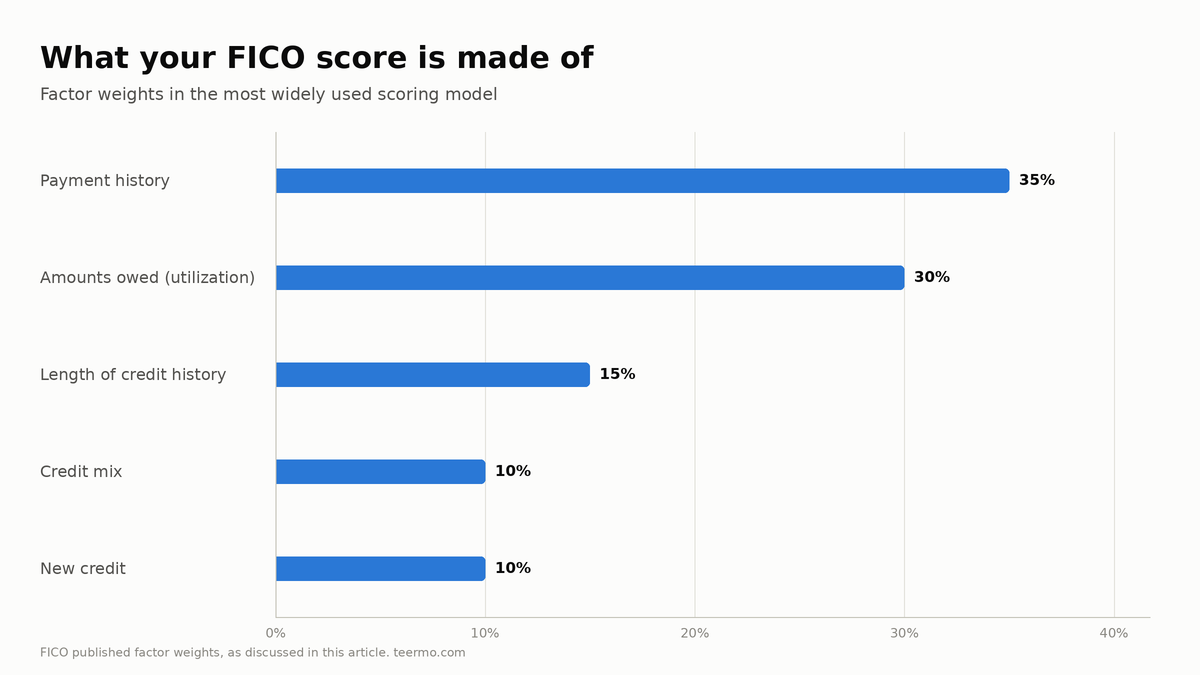
FICO, the most widely used scoring model, weighs five factors: payment history (35%), amounts owed — mostly your credit utilization (30%), length of credit history (15%), credit mix (10%), and new credit (10%).
Look at those first two numbers. Payment history and utilization together control about 65% of your score — and utilization is the one you can change almost immediately. That’s why every fast-improvement strategy starts there.
The 15% for history length is why you shouldn’t expect miracles on a six-month-old file, and the 10% for new credit is why a flurry of applications backfires. We’ll use all five deliberately.
Raise Your Credit Score Fast: The Two Levers That Move First
Step 1: Push Your Card Balances Below 30% — Then Aim for Under 10%
Utilization is your reported card balance divided by your limit, per card and overall. Score models treat high utilization as risk right now, which means lowering it helps right now — there’s no memory of last month’s balance.
Say you have a $2,000 limit and a $1,400 balance: that’s 70% utilization. Pay it to $500 and you’re at 25%; to $180 and you’re under 10%, where the best scores live. Many people see meaningful movement within one or two statement cycles after a big paydown.
Need to free up cash to do it? Our readers’ favorite starting point is this list of 25 ways to save money fast.
Step 2: Time Your Payment Before the Statement Date
Here’s the quiet detail almost nobody uses: most card issuers report your balance as of your statement closing date, not your due date. Pay your balance down a few days before the statement closes, and the bureaus see the low number — even if you spend normally all month.
Paying before the statement date is the fastest legitimate score trick that exists, because it changes what gets reported without changing anything about your spending.
Clean Up What’s Already on Your Report
Step 3: Pull All Three Reports and Dispute Errors
You’re entitled to free reports from all three bureaus at AnnualCreditReport.com — the official site, no card required. Read them line by line: accounts you don’t recognize, late payments you didn’t make, balances that were paid off, someone else’s data mixed into your file.
Disputes are free, filed online with each bureau, and typically resolved within 30 days. Removing a wrong late payment or a not-yours collection can move a score more than months of good behavior.
Step 4: Handle Late Payments and Collections Strategically
One 30-day late mark hurts; a pattern hurts much more. If you have a single recent late payment on an otherwise clean account, call the issuer and ask for a goodwill adjustment — polite, specific, and surprisingly effective with long-time customers.
For collections: paid collections stop dragging on newer scoring models, and some collectors will agree in writing to request deletion on payment. Get any agreement in writing before you pay. Never revive an old debt past your state’s statute of limitations without understanding the consequences.
Build Positive History Without New Debt
Step 5: Become an Authorized User on an Old, Clean Card
If a family member has a years-old card with perfect payment history and low utilization, being added as an authorized user can graft that history onto your file. You don’t need to use — or even hold — the physical card.
Choose carefully: their high balance or late payment becomes your problem too. This works best for thin files and short histories, where that 15% length factor is starving.
Step 6: Add One On-Time Tradeline If Your File Is Thin
A secured card (your deposit becomes your limit) or a small credit-builder loan gives the bureaus something positive to record every month. Set it to autopay, put one small recurring bill on it, and let it quietly report.
One perfectly-paid account reporting for six months does more than any hack — it’s the raw material every score is built from. Just don’t open several at once; each application’s hard inquiry nicks that 10% new-credit factor.
Step 7: Keep Old Cards Open and Stop Applying
Closing your oldest card shortens your average history and cuts your total limit — both negative. If a no-fee card is gathering dust, put one small subscription on autopay and leave it alone. And during the months before a big application, freeze all new credit applications entirely.
What Results to Expect — Honestly
Rhetorical question worth asking: how fast is “fast”? If your score is depressed by high utilization, big paydowns can show up in 30–60 days. Error removals show up when the dispute resolves. Thin-file building takes about six months to demonstrate a pattern.
What nobody can do quickly: erase accurate negative history. Anyone charging money to “remove real late payments” is selling something the Consumer Financial Protection Bureau repeatedly warns against. Time plus on-time payments is the only cure for real mistakes — the good news is the effect fades every year.
While your score climbs, make the waiting productive: a stronger score pays off most when your budget is ready to use it. Our $50K salary budget guide pairs well with this plan.
Final Thoughts: Play the Weights, Not the Myths
Most credit advice fails because it treats all actions as equal. They aren’t. Utilization and payment timing move first; error cleanup moves suddenly; history building moves slowly and permanently.
Pick the step that matches your situation: high balances → pay before the statement date; suspicious entries → dispute them this week; thin file → one secured card on autopay. Do the one thing, let it report, then add the next.
Your score isn’t a judgment of you. It’s a formula — and now you know exactly which inputs it rewards.
Frequently Asked Questions
How fast can I realistically raise my credit score?
If high utilization is your main issue, paying balances down before your statement date can move your score within one to two billing cycles. Error disputes typically resolve within 30 days. Building history on a thin file takes roughly six months of on-time reporting.
Does checking my own credit score lower it?
No. Checking your own score or reports is a soft inquiry and never affects your score. Only hard inquiries — actual credit applications — have a small, temporary effect.
Should I pay off collections to raise my credit score fast?
Often yes, because newer scoring models ignore paid collections, and some lenders require them resolved anyway. Where possible, get a written pay-for-delete agreement first, and confirm the debt is valid and within the statute of limitations before paying anything.
Will closing a paid-off credit card help my score?
Usually the opposite. Closing a card reduces your total available credit (raising utilization) and can shorten your average account age. If the card has no annual fee, keep it open with a small recurring charge on autopay.
