

You open your bill, and there it is again — a number bigger than last month. You didn’t add anything. You didn’t change your plan. It just… crept up.
You’re not imagining it. In 2026, nearly three out of four Americans say their internet bill rose over the past year — up from just 43% the year before. Most households now pay between $63 and $81 a month, and a big chunk of that comes from quietly expired “promo” rates.
Here’s the part nobody tells you: that price is not fixed. Learning how to negotiate internet bill costs is one of the fastest, lowest-effort ways to cut your monthly expenses in 2026 — often by $20 to $50, in a single phone call.
So why do so few people do it? Mostly because it feels awkward, or they assume it won’t work. I get it. But by the end of this guide, you’ll have the exact words to say, the right person to say them to, and the timing that makes “yes” far more likely.
Let’s get your bill back under control.

Why You’re Suddenly Paying More (And Why You Can Negotiate Internet Bill Costs Down)
Think of your internet plan like a gym membership. The sign-up deal is amazing. Twelve months later, the “introductory rate” silently rolls into a “standard rate,” and suddenly you’re paying for the privilege of not noticing.
That’s exactly how most providers work. Promotional prices usually last 12 to 24 months, then jump — a $55 plan can balloon to $80 or more once the discount ends.
On top of that come the extras: a $10–$15 monthly modem rental, regulatory fees, and vague service charges. According to a 2026 consumer report, hidden fees pushed the average bill up by about $19 over the advertised price.
The good news is that these inflated rates exist precisely because providers expect most people to never call and complain. That gap between what you pay and what new customers pay is your leverage.
Competition is fierce right now — fiber, cable, and 5G home internet are all fighting for the same households. Retaining you is cheaper than replacing you, and providers know it.
Lower Internet Bill Tips: Do This Before You Pick Up the Phone
Five minutes of prep is the difference between “sorry, no discounts available” and a real win. Walk in unprepared and you’ll get the scripted brush-off. Walk in armed, and you change the whole conversation.
Here’s your quick prep checklist:
- Know your current number. Find your exact monthly total, your plan speed, and whether you’re still under contract.
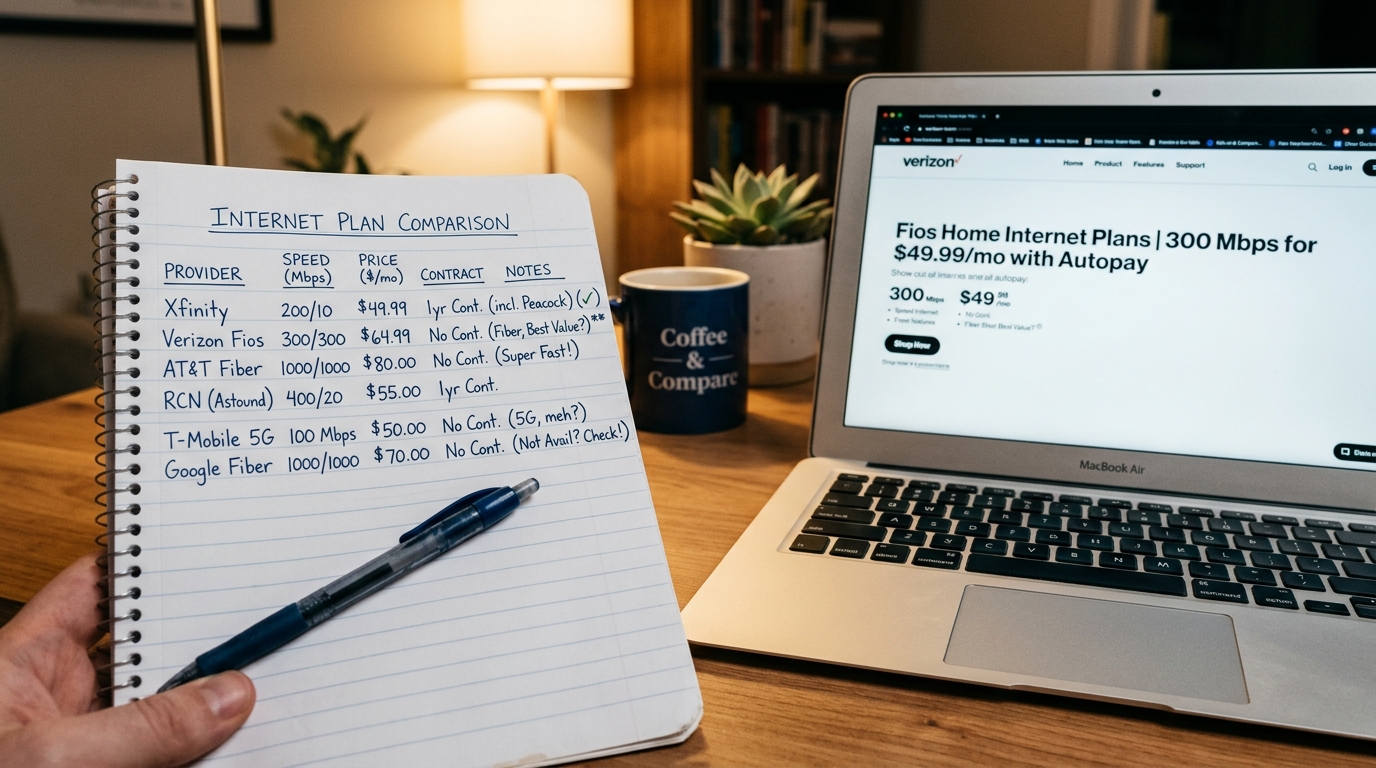
- Scout the competition. Check what other providers in your ZIP code are charging right now. T-Mobile 5G Home, Verizon Fios, AT&T Fiber, and local ISPs often advertise rates 30–50% below what loyal customers pay.
- Check your own provider’s new-customer page. This is gold. If they’re offering 300 Mbps for $40 to strangers, you can ask why you’re paying $75 for the same thing.
- Set your target. Decide the exact monthly price you’d accept before you dial.
Quick reality check: are you even overpaying? In 2026, a fair price for a reliable 100–200 Mbps plan sits around $40–$60, while gigabit plans run $60–$90. If you’re well above that for mid-tier speed, you’ve got room to push.
Related: How to Lower Your Electric Bill Fast — the same negotiation-and-habit approach applied to your electricity costs.
How to Negotiate Internet Bill Costs: The 7-Step Script That Works
Ready for the actual call? Here’s the step-by-step playbook. Read it once, keep it open while you dial, and stay friendly the whole way through.
- Skip the general billing line and ask for the retention or “loyalty” department. The magic sentence is simple: “I’m considering canceling my service and would like to discuss my options.” Frontline reps read from scripts; retention agents hold the real discounts.
- Open calm and human. Something like: “I’ve been a customer for [X] years, and my bill keeps going up. I want to stay, but I need a better rate.” You’re framing this as keeping you, not begging.
- Drop your specific competitor offer. Vague never works. “Verizon is offering 300 Mbps for $39.99” lands far harder than “others are cheaper.” Here’s where Maria, a remote worker in Ohio, won big — she mentioned a local fiber promo by name, and her rep instantly found a $25 credit that “wasn’t showing” a minute earlier.
- Ask for something concrete, not “anything you can do.” Try: a 12-month rate lock at your current promo price, a waived equipment fee, or a specific monthly credit. Specific asks get specific yeses.
- Pause after you ask. Silence is uncomfortable for them, too. Let the rep fill it. Don’t talk yourself out of the discount they’re about to offer.
- Escalate politely if you hit a wall. “I understand you can’t go lower — could you connect me with someone who can, or a supervisor?” A fresh agent on a different day often has different offers in front of them.
- Confirm everything in writing. Repeat the agreed price, the term length, and get a reference number. Then write down the date, the agent’s name, and what was promised.
The single most powerful move here is being genuinely willing to walk away — because retention teams unlock their best deals only when they believe you’ll actually leave.

Negotiate Cable Bill USA Style: Mistakes That Quietly Cost You Money
Even a good script falls apart if you trip over these. Here are the errors I see most often.
Calling the wrong department. The general line is built to upsell, not discount. If you don’t ask for retention, you’ve already lost the strongest card.
Being vague. “Can you lower my bill?” invites a “no.” Name a number and a competitor instead.
Forgetting the modem fee. Renting a router at $10–$15 a month is roughly $150 a year for hardware you could buy once for around $60–$100. Buy your own compatible model and that fee vanishes regardless of how the call goes.
Getting emotional or rude. Agents have discretion. Frustration aimed at them shrinks your discount; warmth expands it.
Accepting the first “no.” Mood and available promos vary by agent and by day. A polite call-back tomorrow is a real strategy, not a fantasy.
Ever notice how the deal magically appears the moment you sound serious about leaving? That’s not luck — that’s the system working as designed.
Reduce Monthly Internet Cost Even More: Beyond the Phone Call
Negotiating is step one. Stack these and your savings compound.
Check assistance programs. If money is tight, you may qualify for discounted plans like Xfinity Internet Essentials, Spectrum Internet Assist, or a state program — sometimes dropping the bill to $10–$30 a month.
Reconsider the bundle. Bundles can save money, but if you barely watch the cable TV you’re paying for, unbundling to standalone internet is often cheaper. Run the math both ways.
Try wireless home internet. J.D. Power found wireless internet customers pay around $72 a month versus $81 for wired — and many report fewer outages after switching. T-Mobile and Verizon 5G home plans are worth a look.
Ask your employer. Some companies subsidize home internet for remote staff as a benefit. One quick email to HR could be the easiest $50 you ever save.
For a deeper dive on broadband savings tips and current pricing benchmarks, the consumer team at Reviews.org tracks these numbers year over year.

Final Thoughts: Your Bill Is a Conversation, Not a Verdict
Remember that creeping number at the top of this article — the one that climbed without your permission? You now know it was never carved in stone.
The truth is, your provider has been counting on your silence. The moment you call retention, name a competitor, and ask for a specific price, you flip the dynamic. You stop being a passive line item and become a customer they’d rather keep than lose.
You don’t need to be a smooth talker or a hard negotiator. You just need ten minutes, a little prep, and the willingness to say, “I’m thinking about leaving.” Most people who try this walk away $20–$50 lighter on their monthly bill — money that’s now yours every single month, for doing something you can finish before your coffee gets cold.
So here’s your move: block out ten minutes this week, grab your latest bill, and make the call. Save this guide, and come back to the script when you dial.
Your bill went up without asking. It’s time to bring it back down on purpose.
Related: No Spend Challenge Rules — another fast way to reclaim cash by cutting spending across every category for a set period.
Frequently Asked Questions
Q: How much can I realistically save when I negotiate my internet bill?
Most people save $20–$50 a month, and surveys show internet bills rose by roughly $20 on average recently — so you’re often just clawing back a recent hike. Your savings depend on how long you’ve been a customer, local competition, and whether your promo rate has expired. The biggest wins usually come right after a price increase or at contract renewal.
Q: What exactly do I say to start the negotiation?
Ask to be transferred to the retention or loyalty department, then say, “I’m considering canceling and want to discuss my options.” That single sentence routes you to agents with real discount authority. Follow it with a specific competitor price and a clear target number.
Q: What if there’s only one internet provider in my area?
You can still negotiate, just with different leverage. Ask the retention team to match the rate they offer new customers, request a waived modem fee, or check if you qualify for an assistance program. Buying your own router also trims the bill no matter what the provider says.
Q: How often should I negotiate my internet bill?
Once a year is a smart rhythm, ideally when your promotional rate is about to expire or right after you get a price-increase notice. Set a calendar reminder so a quiet rate hike doesn’t sneak past you again. Each call takes about ten minutes and can pay off for the next twelve months.
