

Your renewal notice arrives, and the number is higher. Again. You haven’t had an accident, you haven’t moved, and somehow you’re paying more than last year for exactly the same coverage.
If that sounds familiar, you’re in good company — US auto premiums have climbed steeply over the past few years, and most drivers just pay the increase. But here’s what insurers don’t advertise: the price you’re quoted is a starting point, not a verdict.
This guide walks through nine ways to lower car insurance costs that actually work in 2026 — no gimmicks, no letting your coverage quietly lapse. Some take ten minutes. A couple can cut hundreds of dollars a year on their own. By the end you’ll know exactly which levers apply to you and which to pull first.
Why Your Premium Keeps Rising (Even When You Do Nothing Wrong)
Premiums aren’t just about your driving. Insurers price in repair costs, used-car values, medical costs, and how expensive claims are in your ZIP code. When those rise — and they have — everyone’s rate rises with them.
There’s a second, quieter reason: loyalty pricing. Many insurers count on long-time customers not shopping around, so renewal rates drift upward faster than new-customer quotes for identical coverage.
That gap between your renewal price and a new customer’s price is where most of your savings hide. Think of the rest of this article as a checklist for closing it.
How to Lower Car Insurance: Start With These Three Moves
1. Get Three Quotes Every Renewal (The Single Biggest Lever)
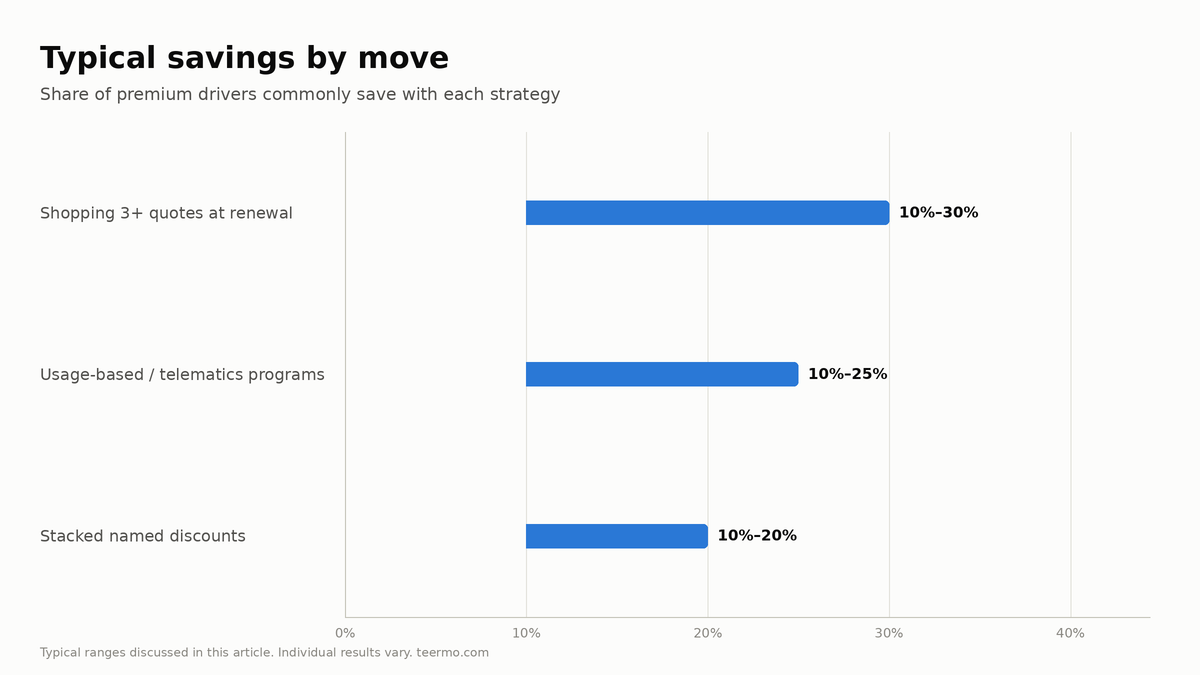
Boring? Yes. Effective? More than everything else on this list. Rates for the same driver and the same coverage routinely differ by 30% or more between companies, because each insurer weighs your profile differently.
Maria, a teacher in Ohio with a clean record, did nothing but re-quote her policy at renewal: same limits, same deductibles. Her existing insurer wanted $1,860 a year. The third quote came in at $1,240. That’s $620 for about forty minutes of typing.
Use at least one independent agent or comparison site plus two direct insurers, and compare identical limits — a cheaper quote with lower liability limits isn’t a saving, it’s a downgrade.
2. Raise Your Deductible — With a Rule
Moving a collision deductible from $500 to $1,000 typically trims the collision portion of your premium noticeably. The rule that keeps this safe: only raise your deductible to a number you could actually pay tomorrow.
If you’ve built even a starter emergency fund, you’re effectively self-insuring the small stuff and paying the insurer only for the big stuff — which is what insurance is for. If you haven’t started that fund yet, our guide on 25 simple ways to save money fast is the place to begin.
3. Ask for Every Discount by Name
Insurers rarely apply discounts automatically. On one call, ask about: multi-policy (bundling renters or home), multi-car, good student, defensive-driving course, low mileage, pay-in-full, paperless, and occupation or affinity groups.
None of these is huge alone. Stacked, they commonly shave 10–20% off. The good-student discount alone can be significant if you’re insuring a teen driver with a B average or better.
Match Your Coverage to Your Car (Where Older Cars Save You Money)
Collision and comprehensive coverage pay out at most what your car is worth. On a car worth $3,500, paying $600 a year for full coverage with a $1,000 deductible means insuring a maximum real payout of $2,500. At some point, that math stops working.
A common rule of thumb: when annual full-coverage cost exceeds about 10% of your car’s value, it’s time to run the numbers on dropping it. Check your car’s current value on a pricing guide, then decide with real figures — never drop the liability coverage that protects you from other people’s bills.
Have a question worth asking here? “If this car were totaled tomorrow, would the payout genuinely matter to my finances?” If the honest answer is no, you’ve found money.
Usage-Based and Pay-Per-Mile: Good Deal or Trap?
Telematics programs — the app or plug-in device that watches your driving — now offer some of the largest discounts available, often 10–25% for smooth-driving, low-mileage drivers.
They’re genuinely worth it if you drive under roughly 8,000–10,000 miles a year, avoid late-night driving, and don’t brake hard often. They’re a bad fit if your commute is stop-and-go at rush hour, because hard-braking events can price some drivers up, not down.
Check whether your insurer’s program can raise your rate or only lower it before enrolling — the answer varies by company and state, and it changes the risk of trying it.
Fix the Cheap Stuff: Credit, Lapses, and Your Address Details
In most states, insurers use a credit-based insurance score, and it moves premiums more than people expect. The same habits that raise your credit score — on-time payments and low card balances — quietly lower car insurance costs too. We cover the fastest levers in our guide to raising your credit score.
Two more silent price-setters: never let a policy lapse, even for a week, because a coverage gap marks you as higher-risk for years; and make sure your annual mileage and garaging address on file are accurate — commuting 5 miles while rated for 25 is money left on the table.
According to the Insurance Information Institute, shopping the market and maintaining continuous coverage are two of the most reliable ways US drivers keep premiums down over time.
9 Ways to Lower Car Insurance in 2026: The Full Checklist
- Re-quote with 3+ insurers at every renewal — the biggest single saving.
- Raise your deductible to the highest amount your emergency fund covers.
- Ask for every discount by name — bundling, good student, pay-in-full, low mileage.
- Drop collision/comprehensive on low-value cars after checking the 10% rule.
- Try usage-based pricing if you’re a low-mileage, smooth driver.
- Keep your credit healthy — it feeds your insurance score in most states.
- Never let coverage lapse, even between cars — keep a cheap liability policy active.
- Correct your mileage and address details so you’re rated for how you actually drive.
- Re-shop after life changes — moving, marrying, improving credit, or a ticket falling off your record all reset the math.
You don’t need all nine. Most drivers who do the first three see a meaningful drop within one renewal cycle.
Mistakes That Cost More Than They Save
Cutting liability limits to the state minimum is the classic false economy — it saves a little now and exposes everything you own in a serious accident. So is choosing an insurer purely on price without checking complaint ratios, or “saving” by letting a policy lapse between cars.
The goal is a lower price for real protection, not a low price for coverage that fails you exactly when you need it. Every strategy above keeps your actual protection intact — that’s the standard to hold any advice to, including ours.
Final Thoughts: Your Renewal Notice Is a Starting Bid
Insurers price for the customer who auto-renews without looking. The moment you stop being that customer, the market starts working for you instead of against you.
Here’s the ten-minute version: pull out your current policy, note your limits and deductibles, and get two comparison quotes this week. If they come back lower, you’ve found recurring money — the kind that shows up every single month without you earning a dollar more.
Put the savings somewhere they’ll compound: your emergency fund, a debt payoff, or the plan in our monthly budget guide. A premium you shrank once keeps paying you back for years.
Frequently Asked Questions
How much can I realistically save by switching car insurance companies?
Drivers who compare three or more quotes commonly find differences of $300–$800 a year for identical coverage, and sometimes more after a life change like moving or improving credit. The saving depends on how mispriced your current renewal is — which you only learn by quoting.
Does getting insurance quotes hurt my credit score?
No. Insurance quotes use a soft inquiry, which doesn’t affect your credit score. You can shop as many insurers as you like without any credit impact.
Is it cheaper to pay car insurance monthly or in full?
Paying in full is almost always cheaper — insurers typically add installment fees or charge a higher rate for monthly billing. If you can’t pay in full yet, ask whether autopay reduces the monthly surcharge, and plan to switch at your next renewal.
How often should I shop around to lower car insurance?
Every renewal — so once or twice a year, depending on your policy term. At minimum, re-quote after any life change: a move, a marriage, a credit improvement, adding or removing a driver, or a violation falling off your record.
