Rent went up. Groceries went up. Gas, insurance, streaming — all up. And your paycheck? Probably not enough to match it. If you’re staring at your bank app wondering how anyone is supposed to survive on a tight income right now, you’re not alone — and you’re not failing.
Figuring out how to budget on 2000 a month in 2026 isn’t about cutting joy out of your life. It’s about getting honest with the numbers so they stop sneaking up on you. A $2,000 monthly income is real money — it just needs a real plan.
Here’s the thing: most “budgeting advice” online is written for people earning twice that. The percentages don’t fit. The categories don’t match. And the tone is usually a little condescending.
This guide is different. You’ll get a full 2026 budget breakdown, the exact categories that matter, what to cut first when things get tight, and a step-by-step plan you can apply this week. No shame. No fluff. Just numbers that work.


Why Learning How to Budget on 2000 a Month Matters More in 2026
Living costs in 2026 have shifted in a way most income brackets weren’t ready for. Rent in mid-sized US cities has climbed steadily, grocery prices haven’t returned to pre-2022 levels, and even basic utilities cost noticeably more than they did just two years ago.
According to the Bureau of Labor Statistics Consumer Price Index, the prices of food at home, housing, and transportation have all risen meaningfully over the past 24 months. For someone earning $2,000 a month, every dollar now does about 8–12% less work than it did in 2023.
That’s not your fault. That’s math.
So why does a clear budget matter even more now? Because when prices rise and income doesn’t, the only lever you still control is allocation. You can’t always earn more this month — but you can absolutely decide where each dollar goes before it disappears.
I know someone — let’s call her Maya — who lives in Ohio on roughly $2,000 a month from a part-time job plus freelance design work. Two years ago, she felt broke and confused. Today, she pays rent, eats well, and even saves $80 a month. Nothing changed in her income. The only thing that changed was her plan.
That’s the whole game.
The Realistic 2000 a Month Budget Breakdown (2026 Edition)
Let’s get into actual numbers. A common framework is the 50/30/20 rule — 50% needs, 30% wants, 20% savings — but on $2,000 a month, that often breaks down because needs alone can eat 65–75% of income in 2026.
So here’s a more realistic split for a 2000 a month budget breakdown, built for current prices:
| Category | % of Income | Dollar Amount |
|---|---|---|
| Rent / Housing | 35–40% | $700–$800 |
| Utilities & Phone | 7–8% | $140–$160 |
| Groceries & Household | 12–15% | $240–$300 |
| Transportation | 8–10% | $160–$200 |
| Health & Insurance | 5–7% | $100–$140 |
| Personal & Wants | 5–8% | $100–$160 |
| Savings / Emergency Fund | 5–10% | $100–$200 |
| Debt Payments (if any) | 5–10% | $100–$200 |
The biggest win on a $2,000 budget is keeping rent under 40% of your income — it’s the single biggest decision that determines whether everything else fits.
Notice savings is still in there. Even $50/month adds up to $600 a year, which is enough to cover most one-time emergencies (a tire, a copay, a broken phone screen). Pair this with a sinking fund for predictable irregular costs and you stop being blindsided entirely.
Living on 2000 Monthly: Where Your Money Actually Goes
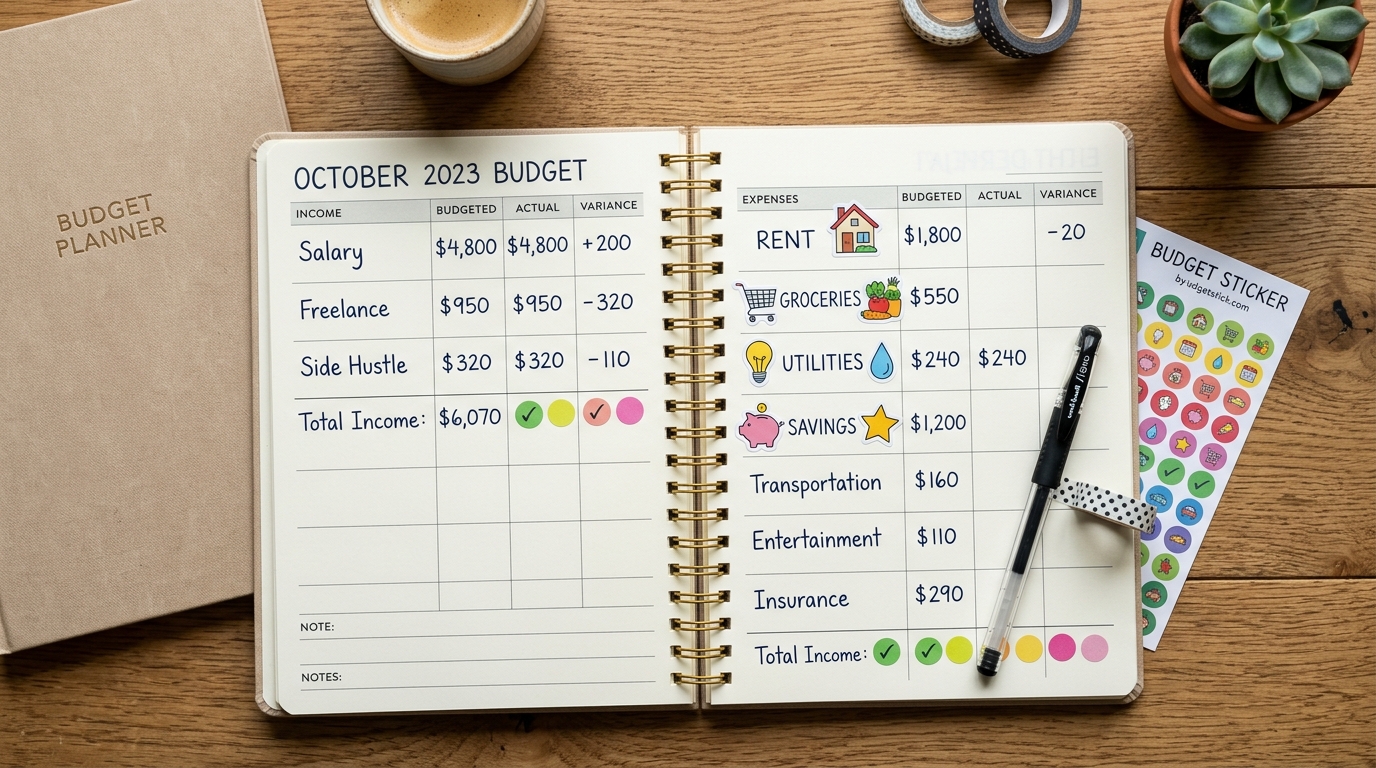
Living on 2000 monthly looks very different depending on where you live, whether you have dependents, and whether you carry debt. Let’s walk through a real, realistic budget 2026 example for a single adult in a low-to-moderate cost-of-living area.
Sample monthly budget — single adult, no kids, no car payment:
- Rent (room in shared apartment): $750
- Electric + internet + phone: $145
- Groceries (cooking most meals at home): $260
- Gas + transit: $130
- Health insurance (subsidized marketplace plan): $95
- Personal care, clothing, small treats: $90
- Streaming + subscriptions: $25
- Savings: $80
- Debt payment (credit card minimum + extra): $150
- Buffer / miscellaneous: $75
Total: $1,800. Leftover: $200.
That $200 isn’t there to disappear into impulse buys. It’s the breathing room that prevents the whole plan from collapsing when your car needs an oil change or a friend’s birthday lands the same week as your phone bill.
A low income budget example like this only works when you treat the buffer as sacred. The moment “leftover” gets spent automatically, you’re back to month-to-month panic.
Is this tight? Yes. Is it doable? Absolutely — millions of people are doing it right now. If you’re starting from zero and need a baseline, our guide on how to start a budget with no money builds the same foundation from scratch.
How to Budget on 2000 a Month: 7 Steps That Actually Work
Here’s the step-by-step system. Do these in order — skipping ahead is what causes budgets to fail.
Step 1: Track every dollar for 14 days. Before you build a plan, you need to know where your money is actually going right now. Use a free app like Credit Karma’s budget tool, Monarch, or a plain spreadsheet. No judgment — just data.
Step 2: Separate fixed costs from flexible costs. Fixed = rent, insurance, phone. Flexible = food, gas, fun. You can’t easily change fixed costs this month, but you can shave 10–20% off flexible costs almost immediately.
Step 3: Set a hard grocery number. This is where most $2,000 budgets quietly leak. Cap groceries at $60–$70 per week and plan meals around what’s on sale. Maya cut her food bill by $90/month just by switching to one big Sunday shop instead of three impulse trips.
Step 4: Automate the boring stuff. Set bills to autopay (after confirming you have the cash). Set up an automatic $25–$100 transfer to savings on payday. The dollars you never see are the dollars you don’t spend.
Step 5: Build a $500 starter emergency fund first. Before aggressively paying down debt, get $500 in a separate savings account. This stops one bad day from putting you back on a credit card.
Step 6: Attack one debt at a time. Pick the smallest balance (snowball) or the highest interest rate (avalanche). Either works — what matters is picking one and not splitting effort across five.
Step 7: Review weekly, not monthly. A monthly review is too late to course-correct. A 10-minute Sunday check-in on your spending keeps small slips from becoming month-end disasters.
These seven steps are the entire system. Boring, repeatable, and effective. For a complementary approach, the envelope budgeting method adds a physical layer that makes the limits impossible to ignore.
5 Mistakes That Quietly Destroy a 2000 Dollar Budget Plan
A 2000 dollar budget plan rarely fails because of one big disaster. It fails from small, repeated leaks. Watch for these:
Mistake 1: Treating “subscriptions” as small. That $9.99 here and $14.99 there can quietly add up to $80–$120 a month. Cancel everything you didn’t actively use in the last 30 days.
Mistake 2: Confusing wants with needs. A phone plan is a need. The latest phone is a want. Coffee at home is a need. A $6 oat milk latte five days a week ($120/month) is a want.
Mistake 3: Skipping the buffer. A budget with zero margin is a budget that breaks the first time something unexpected happens — and something always does.
Mistake 4: Borrowing from savings for non-emergencies. “I’ll put it back next month” almost never happens. Make a rule: savings is invisible until there’s a real emergency.
Mistake 5: Comparing your budget to someone else’s. Your coworker on $4,500/month is not running the same race. Compare your budget today to your budget six months ago — that’s the only honest scoreboard.
Fixing even two of these usually frees up $50–$150 a month. That’s a meaningful win on a tight income.
How to Increase Margin Without Earning More
Sometimes the answer isn’t another spreadsheet — it’s a structural change. Here are five real moves that have made the biggest difference for people figuring out their monthly expenses on 2000:
- Find a roommate or downsize — the single biggest lever, often saving $200–$400/month
- Switch to a prepaid phone plan (Mint Mobile, US Mobile, Visible) — typically $15–$30/month vs $60–$90 on a major carrier
- Use a cashback grocery app like Ibotta or your store’s loyalty program — $10–$25/month back
- Negotiate your internet bill once a year — a 15-minute call often saves $15–$30/month
- Cook five dinners a week — even simple meals at home cost 60–70% less than takeout
None of these are dramatic. But stacked together, they can free up $300–$500 a month without you earning a single extra dollar.
And if you do have some flexibility — a few hours a week — a side income of even $200/month on top of $2,000 takes you from surviving to genuinely stable. Our list of ways to save money fast covers both the cut and earn side of the equation.
Final Thoughts: A Budget Living Guide You Can Actually Stick To
Remember Maya at the start of this article? Her income didn’t change — but her relationship with her money did. That’s what a real budget gives you. Not restriction. Control.
If you’re trying to figure out how to budget on 2000 a month right now, the worst thing you can do is wait until everything feels “ready.” It never will. The categories will shift, the prices will move, and life will throw the occasional curveball. None of that means the plan failed. It means the plan is working — adjusting in real time, the way budgets are supposed to.
You don’t need to be perfect with money. You just need to be honest with it. Start with one step from this budget living guide today — track your spending, set up an auto-transfer, cancel one subscription — and let the small wins compound.
Save this post. Open it again next payday. And next month, you’ll be looking at your bank app with a lot less panic and a lot more clarity.
Once you’ve stabilized this month’s spending, the next move is protecting future-you from irregular expenses. Our sinking funds guide shows how to build that cushion one small contribution at a time.
Frequently Asked Questions
Q: Is it actually possible to live on $2,000 a month in 2026?
Yes — millions of Americans do it, especially in lower cost-of-living areas or with roommates. The key is keeping rent under 40% of income and treating groceries, transportation, and subscriptions as flexible costs you actively manage. It’s tight, but it’s far from impossible with a clear plan.
Q: How much should I save if I only make $2,000 a month?
Aim for 5–10% — between $100 and $200 monthly — even if it feels small. Building a $500 starter emergency fund first is more important than chasing big savings numbers. Once that’s in place, increase savings gradually as you trim other categories.
Q: What’s the biggest expense to cut first on a $2,000 income?
Housing, almost always. If rent is eating 50% or more of your income, no amount of cutting coffee or subscriptions will fix the math. A roommate, a smaller place, or a move to a cheaper neighborhood usually has 10x the impact of any other change you can make.