
You sign the lease, hand over the deposit, and on day three of living alone you realize something nobody warned you about: every single bill has your name on it. No roommate. No safety net. Just you and a Kroger receipt that somehow says $94.
Rent in Columbus jumped again this year, and if you’re trying to figure out a realistic single-person budget in Columbus, Ohio setup for 2026, you’re not being dramatic — the math really is tighter than it was even 18 months ago. Young professionals, students, and remote workers are all feeling it.
Here’s the good news. Columbus is still one of the more livable mid-size cities in the US, and a single income absolutely works here — if you build the budget on real 2026 numbers instead of outdated Reddit threads from 2022.
This guide walks you through honest monthly costs, where solo renters quietly overspend, and a clean step-by-step plan you can copy tonight. By the end, you’ll have a number — your number — and a lot less anxiety about it.
Why a single-person budget in Columbus, Ohio Plan Hits Different in 2026
Living alone anywhere is more expensive per person than splitting with roommates — that part isn’t new. What’s new is the gap.
Rents in popular Columbus neighborhoods like the Short North, Grandview, and Clintonville have climbed steadily, and groceries, car insurance, and renter’s insurance have all crept up alongside them. According to the Bureau of Labor Statistics CPI data, Midwest urban prices have continued rising into 2026, with shelter and services leading the climb.
The reason a single-person budget in Columbus plan matters more now is simple: you no longer have a buffer built into the price of the city itself.
Columbus used to be a place where a $50K salary felt comfortable solo. In 2026, that same salary needs structure. Not panic — structure.
Here’s the thing most articles miss: solo budgeting isn’t about cutting joy. It’s about knowing which $200 actually makes your life better and which $200 quietly disappears into delivery fees and a streaming service you forgot you had.
That distinction is the whole game.
Realistic Monthly Cost Breakdown for Living Alone in Columbus

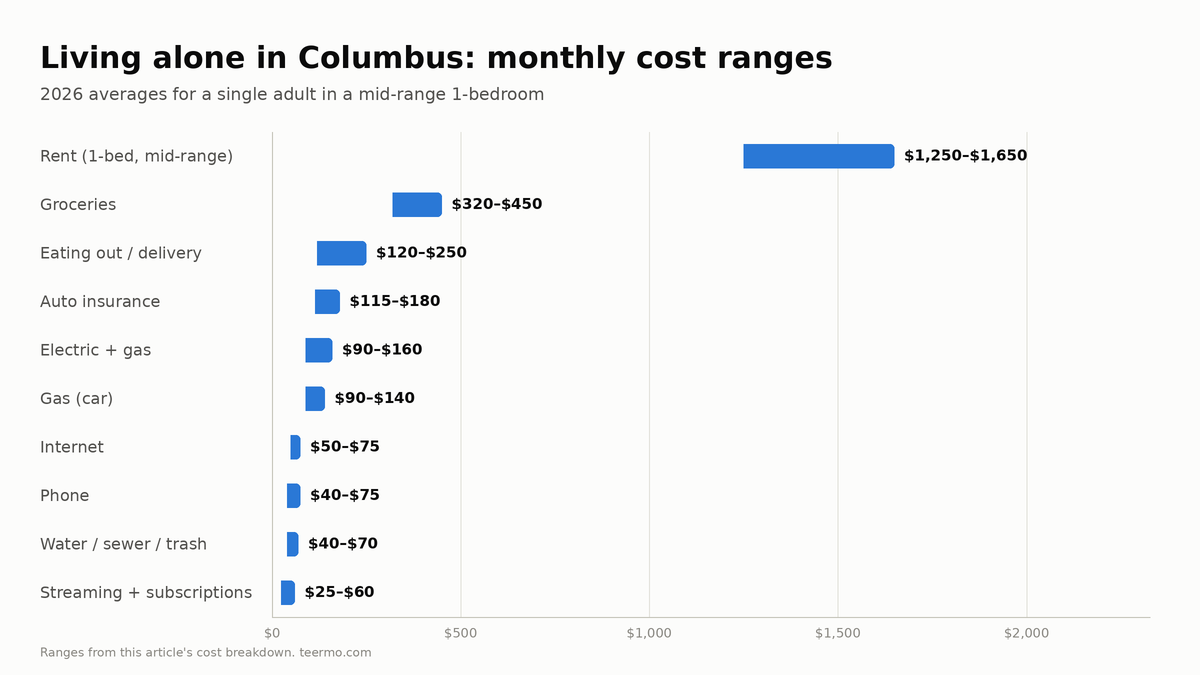
Let me give you the numbers I’d give a friend moving here tomorrow. These reflect 2026 averages for a single adult renting a modest 1-bedroom or studio in a decent Columbus neighborhood — not luxury, not sketchy.
Housing & utilities
- Rent (1-bed, mid-range area): $1,250 – $1,650
- Electric + gas (AEP Ohio / Columbia Gas): $90 – $160
- Water/sewer/trash: $40 – $70
- Internet: $50 – $75
- Renter’s insurance: $12 – $20
Food
- Groceries (cooking most meals): $320 – $450
- Eating out / coffee / delivery: $120 – $250
Transport
- Car payment (if applicable): $0 – $450
- Auto insurance (Ohio average for single adult): $115 – $180
- Gas: $90 – $140
- Parking / COTA pass (if no car): $0 – $62
Personal & lifestyle
- Phone: $40 – $75
- Streaming + subscriptions: $25 – $60
- Gym / fitness: $0 – $50
- Personal care, clothes, misc: $80 – $150
Financial
- Health insurance (if not employer-covered): varies — $0 – $400+
- Savings / emergency fund: aim for $200–$500
- Buffer for surprises: $75 – $150
Add it up honestly and the typical solo living cost Columbus range lands around $2,400 to $3,500 per month, depending on whether you have a car payment and how much you eat out.
That’s the real picture. Anything way under that is either a lucky lease or an incomplete budget.
How to Build Your Monthly Budget Alone in Columbus (Step-by-Step)
You don’t need an app, a spreadsheet expert, or a finance bro to do this. You need 30 minutes and your last two bank statements. Here’s the order that actually works:
Step 1 — Write down your real take-home pay. Not your salary. Your actual deposit after taxes, insurance, and 401(k). This is your ceiling. Every plan that starts with gross income falls apart by week two.
Step 2 — List your fixed costs first. Rent, utilities, insurance, phone, subscriptions, minimum debt payments. These are non-negotiable in the short term. Total them. Subtract from take-home. What’s left is your “everything else.”
Step 3 — Assign the everything-else. Quick mini-scenario: say you’re a remote worker bringing home $3,800/month and your fixed costs eat $2,200. You’ve got $1,600 to split between groceries, gas, fun, and savings. Decide before the month starts — not after.
A clean split many solo Columbus renters use: 40% groceries + transport, 25% savings, 20% fun/lifestyle, 15% buffer.
Step 4 — Build a one-month emergency starter fund. Before chasing bigger goals, park at least $1,000–$1,500 somewhere boring. A single car repair or ER visit will wipe out a budget that has no cushion. This is the most important step for anyone living alone.
Step 5 — Automate everything you can. Savings transfer on payday. Rent on the 1st. Credit card autopay. Decision fatigue is the silent killer of solo budgets. Set it up once and stop thinking about it.
Step 6 — Review weekly, not monthly. Five minutes every Sunday. Just glance at your accounts. Catch leaks early — the $14 free trial you forgot, the surprise Amazon charge — and you’ll save more in a year than any coupon app will ever deliver.
I know what you’re thinking: this sounds like a lot of admin for someone who just wants to live. It’s not. After two weeks it becomes background. After two months it becomes the reason you sleep better.
Where Solo Renters Quietly Lose the Most Money in Columbus
This is the section I wish someone had given me when I started living alone. These are the leaks that don’t feel dramatic — until you add them up at tax time.
Mistake 1: Renting above your actual lifestyle. Columbus has gorgeous apartments in the Short North, Italian Village, and German Village. Walking through one will make a 20% rent increase feel reasonable. It isn’t. Cap rent at 30% of take-home pay, max. A beautiful kitchen doesn’t fix a stressed bank account.
Mistake 2: Buying groceries like you have a household. Single-person shopping is its own skill. Bulk meat goes bad. Family-size produce rots. Build a 4-meal rotation, shop weekly, and use the freezer aggressively. This single shift cuts solo grocery bills by $80–$150 a month.
Mistake 3: Underestimating car costs. Ohio auto insurance for a single adult is creeping up, and Columbus parking and tags add real money. If you live near a COTA line or work hybrid, run the math on going car-light. Sometimes the answer is yes.
Mistake 4: Subscription creep. Streaming, apps, cloud storage, that one wellness platform you signed up for in January. The average solo renter is paying for 9 to 12 active subscriptions. Audit yours every quarter. Half of them won’t survive the audit.
Mistake 5: Skipping the buffer line. This is the big one. A budget without a “weird stuff happens” line item isn’t a budget — it’s a wish. Build in $75–$150/month for the random vet bill, the parking ticket, the friend’s wedding. Future you will be grateful
Smart Ways to Stretch Your Budget Without Killing Your Lifestyle
Cutting your way to a good life never works. Trading better does.
A few moves that have outsized impact for single adults in Columbus:
- Cook 5 nights, eat out 2. Total food spend drops by $200+ a month and the two restaurant nights feel like an event instead of a habit.
- Pick a neighborhood, not just an apartment. Living somewhere walkable (Clintonville, Olde Towne East, parts of Grandview) cuts gas, gym, and entertainment costs at once.
- Use the city for free. Metro Parks, the riverfront, North Market, free museum days at COSI and the Columbus Museum of Art — Columbus has more free joy than most cities its size.
- Buy quality once. A $60 chef’s knife outlasts five $15 ones. A good winter coat outlasts three cheap ones. Single-person economics reward durability.
- Renegotiate yearly. Internet, insurance, phone — every January, call and ask for the retention rate. Twenty minutes can save you $300 a year.
Notice what these have in common? None of them require deprivation. They just require attention.
Final Thoughts
Remember that first month feeling — the lease, the deposit, every bill with only your name on it? That doesn’t go away because you found a magic spreadsheet. It goes away because you build a system that handles it for you.
A workable single-person budget in Columbus plan in 2026 isn’t about squeezing your life into a punishing number. It’s about knowing your real costs, building a small buffer, and making sure the money you spend actually shows up as joy or stability in your week.
You’re allowed to live alone and live well here. Columbus still rewards the people who plan a little. The rising costs are real, but so is your ability to handle them — with structure instead of stress.
Pick one thing from this guide and do it today. Open your banking app, list your fixed costs, or cancel one subscription you forgot about. That’s it. That’s the first step. The rest builds itself.
Frequently Asked Questions
Q: How much income do I need to live alone comfortably in Columbus in 2026? A: A take-home pay of around $3,800–$4,500 per month is a comfortable single-person target in Columbus right now — roughly a $55K–$65K gross salary depending on benefits and debt. You can do it on less, but you’ll need to be intentional about rent and transportation choices. Anything under $40K gross gets tight fast unless you have a rent-controlled situation or no car payment.
Q: What’s a realistic rent for a single person in Columbus right now? A: A modest one-bedroom in a decent Columbus neighborhood runs $1,250–$1,650 in 2026, with studios slightly lower and trendy areas like the Short North or Grandview pushing $1,700+. Try to keep rent at or below 30% of take-home pay. If you go above that, every other category in your budget will feel squeezed.
Q: Is Columbus still affordable compared to other Midwest cities for solo living? A: Yes, but the gap has narrowed. Columbus is still cheaper than Chicago or Minneapolis and roughly comparable to Indianapolis or Cincinnati, with stronger job growth than most. The “Columbus is cheap” reputation is outdated — it’s now best described as reasonable for what you get, especially if you choose your neighborhood carefully.
BLS CPI Midwest data (https://www.bls.gov/cpi/) and Columbus city official data portal for verifying 2026 cost figures