You sign the lease, stare at the number, and feel that little knot in your chest tighten. Rent in Columbus isn’t supposed to feel like this — but in 2026, it absolutely does.
The city’s average rent now sits around $1,341 a month, and one-bedrooms in popular neighborhoods like Harrison West and Indianola Terrace push past $1,700. For anyone earning under $50K, that means rent is quietly swallowing 35%, 40%, sometimes 50% of every paycheck.
Figuring out how to budget high rent Columbus, Ohio renters are facing right now isn’t about willpower or skipping lattes. The old “30% rule” was written in 1969, and the math just doesn’t hold up anymore. You need a new system — one built for the way Columbus rent actually behaves in 2026.
This guide walks through real numbers, the budgeting framework that replaces the broken 30% rule, neighborhood-level cost differences, and the small moves that quietly free up $200–$500 a month. No fluff. No “skip avocado toast.” Just a plan.
Why the 30% Rule Doesn’t Work for High Rent in Columbus, Ohio Anymore
Here’s the thing nobody tells you: the 30% rent rule came from a 1969 federal housing policy called the Brooke Amendment. It capped public housing rent at 25% of income, later bumped to 30% in the 1980s. It was never designed for a private-market renter in 2026 dealing with student loans, 401(k) contributions, healthcare premiums, and Columbus rents climbing 2–3% a year.
A renter earning $45,000 has a gross monthly income of $3,750. The 30% rule says spend up to $1,125 on rent. But Columbus’s average rent is $1,341, and the average one-bedroom in the city sits around $1,192–$1,463. The math is already broken before you’ve paid a single bill.
Then there’s the gross-vs-net trap. The rule uses gross income — what you make before taxes. Your actual take-home on $45K is closer to $2,850. Suddenly that $1,125 “affordable” rent is 39% of your real money. Most Columbus renters now spend 35–45% of their take-home pay on rent, and that’s the reality this guide is built around.
Over 21 million U.S. renters now exceed the 30% threshold. According to Harvard’s Joint Center for Housing Studies, housing cost burden has hit record highs nationwide. Columbus isn’t an outlier — it’s just where you happen to live.
The Real Cost of Living Columbus 2026: What You’re Actually Paying
Before you can budget, you need to know the full picture. Columbus rent is just one line item. Here’s what a typical renter is also handling each month in 2026:
- Energy bills: around $216/month (one of the highest in the Midwest, partly because Ohio winters)
- Groceries: roughly 1% above national average
- Transportation: gas around $3.26/gal, plus parking if you’re downtown
- Internet and phone: $80–$130 combined
- Renters insurance: $15–$25
- Health insurance copays, subscriptions, the occasional car repair: budget $150 minimum
Add it up. For a renter paying $1,200 in rent, total fixed monthly costs often land between $1,800 and $2,100 before a single dollar of food, fun, or savings. That leaves brutally little room.
This is why budgeting after rent Ohio renters do has to be ruthless about the “second tier” of expenses, not just rent itself.
I know someone in Old North Columbus paying $850 for a tiny one-bedroom. Cheap, right? But her commute eats 90 minutes a day, gas costs $180/month, and she’s slowly burning out. Cheap rent isn’t always cheap living. Always count the full cost.
How to Budget High Rent in Columbus Using the Cash-Flow Method
Forget percentages for a minute. The most useful budgeting framework right now is what financial counselors call the Baseline Survival Cash Flow method. It’s mechanical, it’s honest, and it works when rent is eating 40% of your income.
Here’s the four-step process:
1. Start with your net pay — the actual deposit that hits your account. Not the offer letter number. The real one.
2. Subtract rigid debt — car payment, student loan minimums, credit card minimums, child support. These are legally non-negotiable.
3. Subtract survival costs — groceries (be honest: $300–$450 solo, $600–$800 with a partner), utilities, gas/transit, basic insurance, phone. Use last month’s bank statement, not your imagination.
4. What’s left is your absolute rent ceiling. Not your gross-income-percentage ceiling. The real one.
Quick example. Sarah, a 26-year-old in Columbus, takes home $3,100/month. She has a $280 car payment and $190 in student loans. Survival costs run her about $720. That leaves $1,910. Save 10% for emergencies ($310), and she can spend up to $1,600 on rent — but only if she wants zero fun money. So she caps rent at $1,250 and protects $350 for life.
That $350 is the difference between surviving Columbus rent and slowly drowning in it.
This is the new model. Percentages are an opinion. Cash flow is a fact.
7 Real Moves to Survive High Rent in Columbus (Without Eating Ramen Forever)
These aren’t theory. They’re what people actually do in this market right now.
1. Pick the right ZIP code, not the trendy one. Northwest Columbus averages $1,802 for a 1BR. Old North Columbus and Franklinton come in at $750–$799. Same city, $1,000/month gap. Westland, Forest Park East, and Linden have real, livable apartments most twenty-somethings never even Zillow.
2. Get a roommate, even if you swore you wouldn’t. Splitting a $1,400 two-bedroom drops your rent to $700. That single decision saves $6,000+ a year. The math is brutal in your favor.
3. Negotiate at lease renewal. Landlords hate vacancies more than tenants hate paying. If the market is soft (and Columbus has been flat-to-slightly-up in 2026), ask for $25–$75 off. About a third of renters who ask get something. Most never ask.
4. Sign a longer lease. A 14- or 18-month lease often comes with $50–$100/month off, because the landlord locks you in. If you’re staying put, take the deal.
5. Audit your subscriptions and “phantom” spending. Most Columbus renters I’ve talked to find $80–$160/month in stuff they forgot they were paying for. Streaming, gym memberships you don’t use, app subscriptions, two music services. Cancel ruthlessly.
6. Switch to a high-yield savings account for your emergency fund. Many online banks pay 4%+ in 2026. On a $3,000 emergency fund, that’s $120/year you weren’t getting before. Free money.
7. Use the 14-day rule for anything over $50. Want it? Wait two weeks. If you still want it, buy it. This single rule kills 60–70% of impulse spending without making you feel deprived.
Stacking even three of these moves frees up $300–$600 a month. That’s not “someday” money — that’s next-month money.
Affordable Living Columbus: Neighborhoods That Still Make Sense

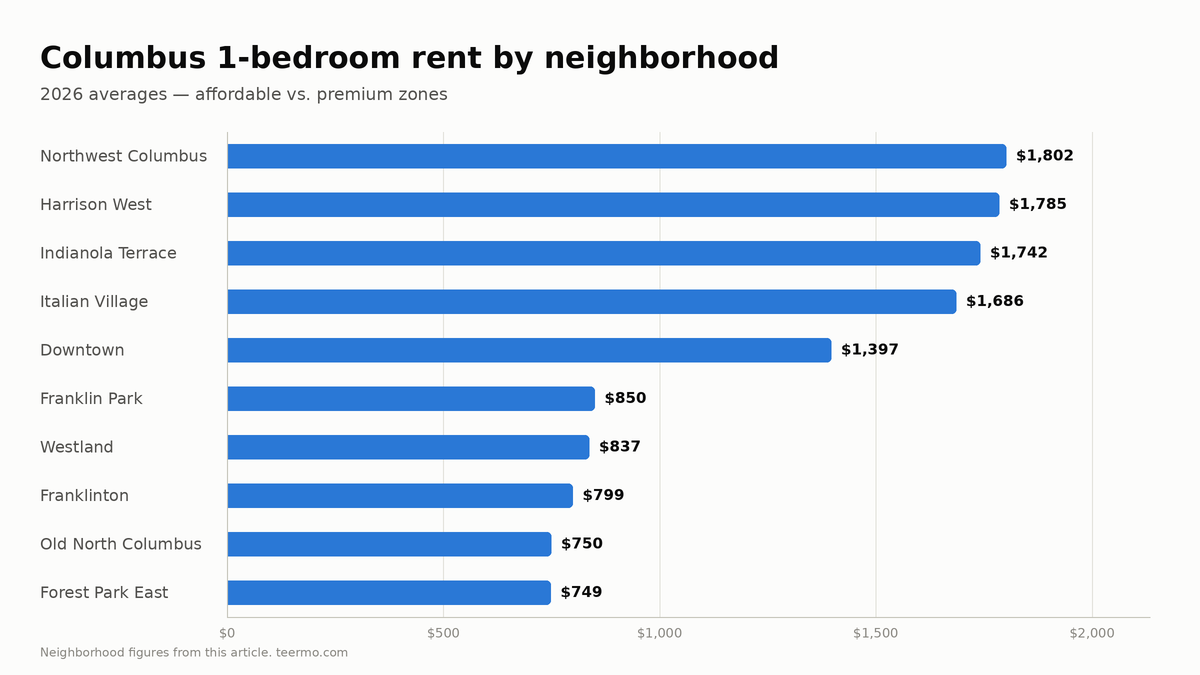
Where you live matters more than almost any other lever. Here’s the honest 2026 breakdown for one-bedrooms:
Genuinely affordable (under $900): Forest Park East ($749), Old North Columbus ($750), Franklinton ($799), Westland ($837), Franklin Park ($850). These aren’t perfect — you trade some walkability and trendy coffee shops — but they keep rent inside a livable budget.
Mid-tier ($900–$1,300): Most of Hilliard, Reynoldsburg, Whitehall, and parts of the Northeast. Solid value, decent commutes, mixed amenities.
Premium zones ($1,400+): Downtown ($1,397), Italian Village ($1,686), Indianola Terrace ($1,742), Harrison West ($1,785), Northwest Columbus ($1,802). Beautiful spots — but only if your income genuinely supports them.
A practical move many young professionals make in 2026: live in a mid-tier neighborhood for two years, save aggressively, then upgrade. The two-year detour to Westland can fund a Roth IRA, an emergency fund, and eventually a Short North apartment. It’s not glamorous. It works.
I know what you’re thinking — “but I want to live somewhere fun.” Totally fair. Just go in with eyes open. There’s no rule that says your twenties have to be expensive. Some of the calmest, happiest renters I’ve met live in $850 apartments and travel twice a year on the money saved.
Final Thoughts: You Can Actually Survive High Rent in Columbus
That knot in your chest when you saw the lease total? It’s real, and it’s not your fault. The system you were taught — 30% of gross, save the rest, you’ll be fine — was built for a different economy. Columbus rent in 2026 doesn’t play by those rules.
But here’s the reframe: you don’t need the old rules. You need a cash-flow budget, a smart ZIP code, two or three high-leverage savings moves, and the patience to let the math compound. People are doing it. Quietly, every day, in this city.
Start with one thing this week. Pick the easiest of the seven tactics above — maybe the subscription audit, maybe asking about a longer lease — and just do it. Small wins build the confidence to tackle bigger ones. The goal isn’t perfection; it’s momentum.
Save this guide. Share it with the friend who keeps stressing about rent. And if you want to go deeper into building an emergency fund from scratch on a tight Columbus budget, .
You’re not behind. You’re recalibrating. That’s a very different thing.
Frequently Asked Questions
Q: What’s a realistic rent budget if I earn $45,000 in Columbus? A: After taxes, your take-home is roughly $2,850/month. A realistic rent ceiling is $850–$1,050, leaving enough for utilities, food, transportation, and at least $200/month in savings. Use the cash-flow method above instead of the 30% rule — it gives you a much more honest number.
Q: Is Columbus rent really that expensive compared to other cities? A: Columbus is actually 27–29% cheaper than the national average — but local wages haven’t kept up with the 13%+ jump in one-bedroom rents some sources have tracked over the past year. So while Columbus is “affordable” on paper, it feels increasingly tight in practice, especially for renters earning under $50K.
Q: Should I move further out to find cheaper rent in Columbus? A: Only if the total cost works. Cheaper rent in suburbs like Westland or Pickerington can be erased by a longer commute, higher gas costs, and lost time. Run the full math: rent + transportation + time value. Sometimes a $1,000 in-town apartment beats an $800 one 40 minutes away.