


Here’s a number that should bother you: every year, a meaningful amount of scholarship money goes unclaimed or under-applied-for — not because students aren’t qualified, but because nobody applied. Meanwhile, the same students take on loans they’ll repay for a decade.
The problem isn’t a shortage of money. It’s that most families only know about the famous national awards — the ones with 50,000 applicants — and never learn how to find scholarships where the odds are actually good.
This guide maps the eight places scholarship money really lives in 2026, in order of how winnable they are. Some of these have applicant pools measured in dozens, not thousands. By the end, you’ll have a search system, a calendar, and a realistic sense of what effort turns into money.
How to Find Scholarships: Think Local First, National Last
National scholarships are lottery tickets: worth a few entries, terrible as a plan. Local awards flip the odds — the applicant pool is your town, not the country.
The less searchable a scholarship is, the better your odds of winning it. That’s the principle behind the entire order of this list. Google-able awards attract thousands; the PDF form at your county foundation attracts twelve people.
Quick scenario: Jayden, a high-school senior, spent one weekend applying to five local awards — a rotary club, a credit union, a county foundation, a parent’s employer, and his church. Three paid out: $500, $1,000, and $750. Total applicant pools? Under 40 people each.
The 8 Places Scholarship Money Actually Lives
1. Your School Counselor’s List (Seriously)
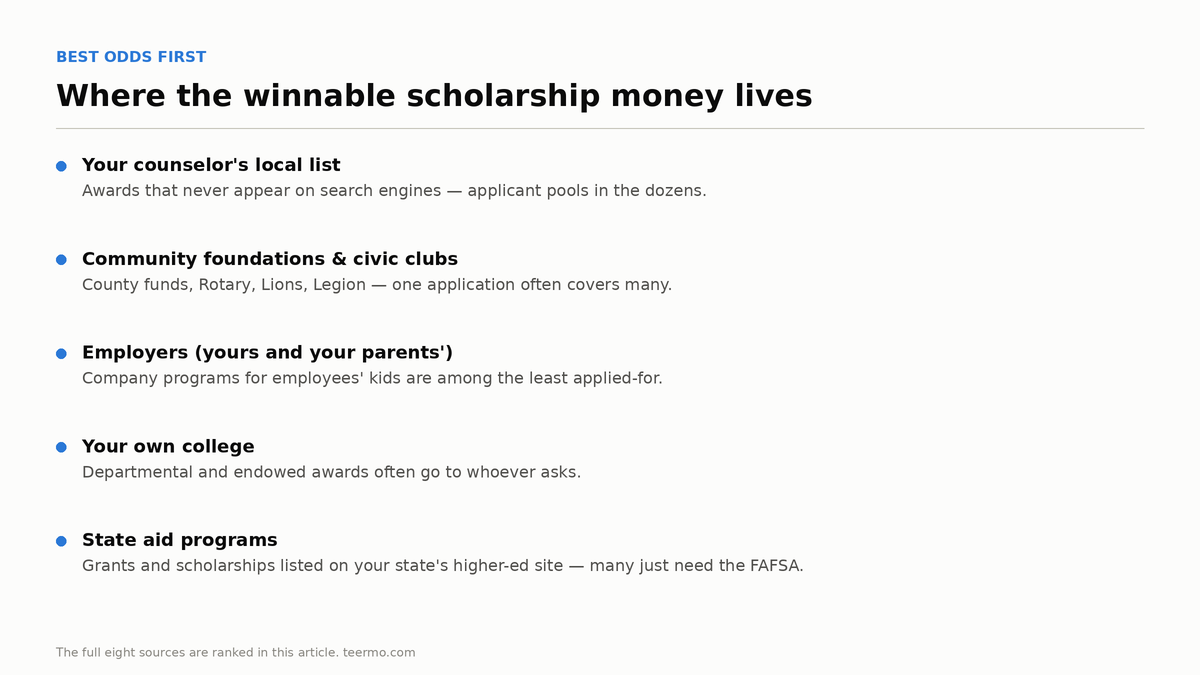
Every high school counseling office keeps a list of local awards that never appear on search engines — memorial scholarships, booster clubs, local business awards. Ask for it by name: “the local scholarship list.” Community college and university financial-aid offices keep the same for current students.
2. Community Foundations and Civic Groups
County and city community foundations manage dozens of small named funds, often with one shared application. Rotary, Lions, Elks, Kiwanis, American Legion — all give annually, all locally. Search “[your county] community foundation scholarships” and you’ll usually find a single portal.
3. Employers — Yours and Your Parents’
Many companies run scholarship programs for employees’ children, and plenty of part-time employers offer tuition help for their own workers. HR knows; ask. This category is one of the most under-applied-for of all.
4. Your (Future) College Itself
The largest scholarships most students ever receive come from the college’s own merit and departmental aid. After you’re admitted, email your department: “Are there departmental scholarships or endowed awards I can apply for?” Many go to whoever asks, because so few students do.
5. State Aid Programs
Nearly every state runs grant and scholarship programs — some based on grades, some on income, some on field of study. Your state’s higher-education agency website lists them all in one place, and many require nothing beyond the FAFSA.
6. Identity, Heritage, and Situation-Based Awards
First-generation students, specific heritages, military families, students who’ve been in foster care, children of first responders — dedicated funds exist for all of these. These matter because the pool is limited by definition, which moves the odds back toward you.
7. Major-Specific and Professional Associations
Whatever you plan to study, its professional association almost certainly funds students — engineering societies, nursing associations, accounting bodies, trade organizations. These double as networking that pays off at internship time.
8. The Big Search Engines — Used Correctly
Sites like the College Board’s scholarship search and the Department of Labor’s CareerOneStop scholarship finder are worth one thorough session with every filter filled in — then weekly alerts, not daily scrolling. Treat them as the finishing layer, not the foundation.
Build a Scholarship System, Not a Panic
Winning students treat this like a part-time job with a spreadsheet. Four columns: name, amount, deadline, requirements. Fill it during one focused weekend using the eight sources above, then work deadlines in order.
Reuse is the whole secret of scholarship efficiency. Write one strong personal essay and one activities list, then adapt them — most applications ask overlapping questions. Application #5 takes a quarter of the time application #1 did.
Two rules that protect you: never pay to apply (fee-charging “scholarships” are a classic scam), and never miss the FAFSA — plenty of private awards require it, and it unlocks the state and federal money that stacks underneath everything. Our guide on paying for college without loans shows how the full stack fits together.
What About Essays? The Honest Formula
Committees read stacks of essays that all say “I’m hardworking and passionate.” The ones that win tell one specific story with a beginning, a struggle, and a change — then connect it to what the money makes possible.
Would you rather read “I have always been passionate about helping others,” or the story of the Tuesday shift at the food pantry that changed a student’s career plan? So would the committee. Specific beats impressive, every time.
Recycle responsibly: keep your core story, but mirror each scholarship’s own language about what they value. A rotary club and an engineering society are funding different futures — show them the version of yours that matches.
Common Scholarship Mistakes That Cost Real Money
The big four: starting senior year spring (many deadlines fall in fall and early winter), ignoring awards under $1,000 (the low-competition money that stacks), missing renewal paperwork on awards you already won, and blowing deadlines you’d tracked in your head instead of a calendar.
One more that stings: assuming your family “makes too much.” Merit awards, local awards, and field-of-study awards mostly don’t care about income. Apply based on the award’s actual criteria, not your assumptions about them.
Final Thoughts: The Weekend That Pays Better Than Any Side Hustle
Run the math on Jayden’s weekend: $2,250 for perhaps ten hours of work. That’s a better hourly rate than any student job — and it compounds, because every dollar of scholarship money is a dollar that never becomes a loan payment with interest.
Start with the counselor’s list and your county foundation this week. Build the spreadsheet. Apply to the small, local, “boring” awards everyone else skips. The students who win aren’t the most brilliant — they’re the ones who actually applied.
And if you’re also earning your way through school, pair this with our guide to side hustles that pay $1,000 a month — scholarships and income together are how degrees end up debt-free.
Frequently Asked Questions
When should I start looking for scholarships?
Junior year of high school is ideal — many major deadlines fall in the fall of senior year. But it’s never too late: current college students qualify for departmental, association, and local awards every single year they’re enrolled.
Are small scholarships worth the effort?
Usually more than big ones, per hour invested. A $500 local award with 20 applicants is dramatically better odds than a $10,000 national award with 30,000. Small awards also stack — four of them equal a semester’s books and fees.
How do I find scholarships that aren’t scams?
Legitimate scholarships never charge application fees, never guarantee winning, and never ask for bank details to “deposit your award.” Stick to your school’s lists, community foundations, state agencies, and established searches like the College Board or CareerOneStop.
Do I need the FAFSA to get scholarships?
For many, yes. State grants, institutional need-based aid, and a surprising number of private awards require a completed FAFSA. File it as early as possible after it opens — some aid is first-come, first-served.
