Is It Actually Possible to Eat on $200 a Month in 2026?
The skepticism is fair. Grocery prices haven’t been kind. According to the USDA’s food cost reports, the average single American adult spends between $320 and $470 per month on food depending on age and eating habits. $200 is nearly half that.
Last Updated: June 12, 2026
So yes — eating on $200 a month in 2026 requires strategy — and if you’re working with a bigger budget, check out our guide on how to live on $1,500 a month. But it’s a learnable strategy, not a punishment.
Here’s the math that makes it possible:
| Per day | Per meal (3 meals/day) |
|---|---|
| $6.67 | $2.22 |
That’s tight. But eggs cost about 25 cents each. A pound of dry lentils feeds you for four meals and costs under $2. A bag of oats covers 10 breakfasts for $3. The secret isn’t cutting food — it’s cutting the types of food that silently inflate your bill.
The people who fail a $200 food budget aren’t failing because $200 is too little. They’re failing because they’re shopping the same way they always have, just with a smaller number attached. A different budget requires a different method.
Everything in this guide is built around that shift.
How to Break Down a $200 Dollar Monthly Food Budget Week by Week
The first thing to do is stop thinking in months and start thinking in weeks.
$200 a month = ~$50 a week. That’s your operating number. Every shopping trip, $50 is your ceiling.
The $50 Weekly Grocery Split

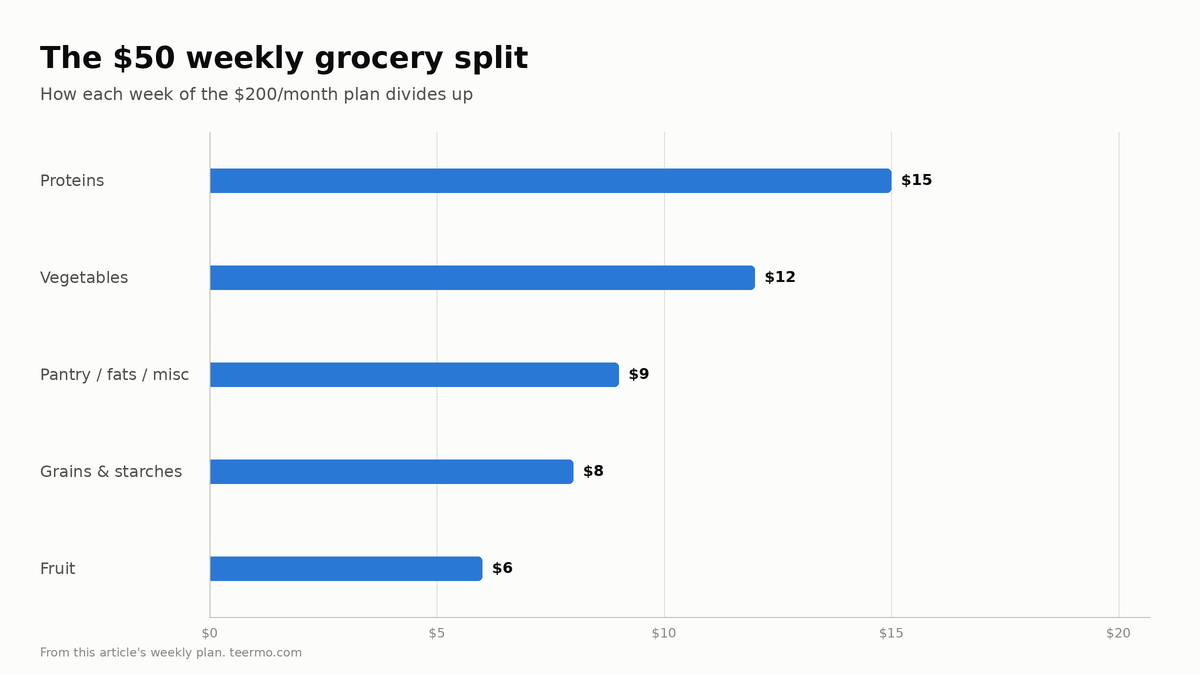
| Category | Weekly Budget | What to Buy |
|---|---|---|
| Proteins | $15 | Eggs, canned tuna, chicken thighs, dry beans, lentils |
| Grains & Starches | $8 | Rice, oats, pasta, bread |
| Vegetables | $12 | Frozen bags + 2–3 fresh items (onion, potato, cabbage) |
| Fruit | $6 | Bananas, apples, or whatever’s on sale |
| Pantry/fats/misc | $9 | Olive oil, canned tomatoes, garlic, spices, butter |
The key: proteins and vegetables are where most people overspend. Boneless skinless chicken breast at $6–7/lb? Swap it for chicken thighs at $1.99–2.49/lb. You get more fat, more flavor, and the same protein per dollar.
A $200 dollar monthly food budget works best when you treat the first week like a pantry-building week. Spend $50–55 buying pantry staples (oil, rice, oats, beans, spices) that will last 2–3 weeks. The following weeks feel dramatically cheaper because the base is already stocked.
Don’t try to buy everything fresh every week. That model is designed for people spending $400+.
The Real 4-Week Meal Plan for How to Eat Healthy on $200 a Month
This meal plan is built for one person. It rotates ingredients to minimize waste, leans on batch cooking, and keeps meals from feeling repetitive.
Week 1 — Pantry Load-In (~$52)
Grocery list: Oats, eggs (18-ct), dry lentils (2 lbs), chicken thighs (3 lbs), brown rice (5 lb bag), frozen broccoli (2 bags), frozen spinach, canned tomatoes (4 cans), onions, garlic, potatoes, bananas, apples, olive oil, butter, soy sauce, cumin, paprika
| Day | Breakfast | Lunch | Dinner |
|---|---|---|---|
| Mon | Oatmeal + banana | Lentil soup (batch) | Chicken thighs + rice + broccoli |
| Tue | Scrambled eggs + toast | Lentil soup leftovers | Rice bowl with fried egg + soy sauce |
| Wed | Oatmeal + apple | Chicken + rice leftovers | Potato + egg scramble |
| Thu | Eggs + toast | Lentil soup (new batch) | Chicken stir-fry with frozen veg |
| Fri | Oatmeal | Leftovers | Pasta with canned tomato sauce |
| Sat | Eggs any style | Rice + beans | Baked potato + butter + frozen veg |
| Sun | Oatmeal | Leftovers | Lentil curry with rice |
Week 2 — Steady State (~$45)
Restock: Eggs, canned tuna (4 cans), fresh cabbage, carrots, bread, bananas, more oats if low, 1 lb ground beef (optional)
Rotate Week 1 dinners. Add tuna salad wraps for lunch. Cabbage stir-fry with egg and soy sauce is a surprisingly good $0.80 dinner. Ground beef stretches across two dinners as tacos or pasta.
Week 3 — Swap Proteins (~$48)
Restock: Canned chickpeas (4 cans), frozen corn, sweet potatoes, yogurt (store brand), any produce on sale
Chickpea curry, sweet potato and egg hash, yogurt + oat parfaits. This is the week most people quit — don’t. You’re two weeks from a full month.
Week 4 — Stretch Mode (~$40–45)
Use up everything in the freezer and pantry. This is intentional: you’re finishing dry goods, using frozen vegetables, cooking through eggs. The goal is to land at $195–200 for the month, not $200 exactly every week.
Total 4-week spend: $185–$200 depending on store prices and sales.
Best Stores for a Food Budget of $200 (Single Person)
Where you shop matters almost as much as what you buy.
ALDI is the single best store for a $200 food budget. Prices run 20–40% lower than Kroger or Safeway on almost every staple — eggs, butter, oats, frozen vegetables, chicken. If you have one nearby, make it your primary store.
Walmart wins on dry goods and store-brand pantry staples. Great Value canned tomatoes, pasta, rice, and beans are consistently the cheapest per-unit option if you don’t have an ALDI.
Ethnic grocery stores (Asian, Indian, Mexican, Middle Eastern) are dramatically underused by people trying to stretch a food budget 200 single person style. Dry lentils, basmati rice, spices, canned goods, and fresh produce often run 30–50% cheaper than mainstream supermarkets. A 4-lb bag of masoor dal at an Indian grocery store: $3–4. At Whole Foods: $8+.
Avoid: Whole Foods, Sprouts, specialty stores, and “convenient” gas station or drugstore food runs for anything beyond emergencies.
One rule for every shopping trip: Check the unit price (price per oz/lb), not the shelf price. Store brands almost always beat name brands at the same quality level.
7 Rules That Make the $200 Monthly Food Budget Actually Stick
People fail budgets not because they lack discipline but because they lack a system. These seven rules are the system.
- Shop with a written list — and don’t deviate. Impulse buys are a $200 budget’s biggest enemy. Everything in the cart should have a corresponding meal.
- Cook in batches, not single servings. Make a big pot of lentil soup on Sunday. It covers 4 lunches. Cook a full tray of chicken thighs. That’s 3 dinners. Cooking once and eating twice (or four times) is how you eat on $200 a month without spending an hour in the kitchen every night.
- Build meals around cheap protein, not expensive protein. Eggs, dry beans, lentils, canned tuna, chicken thighs, and canned chickpeas are your core proteins. Boneless chicken breast, steak, and deli meat are not. This single swap saves most people $40–60/month.
- Frozen vegetables over fresh — almost always. Nutritionally equivalent. Cheaper. Zero waste. A $1.50 bag of frozen broccoli beats $3.50 fresh broccoli that goes soft before Thursday.
- Do one shopping trip per week. Every additional trip to the store adds $15–25 in unplanned spending. One trip. One list. One week.
- Never shop hungry. Cliché. Still true. A hungry stomach is the fastest way to blow $15 on snacks you didn’t need.
- Apply the “pantry first” rule before every list. Before writing your shopping list, open every cabinet and the freezer. If you have rice, eggs, frozen spinach, and canned tomatoes, you already have dinner. Write the list around gaps, not habits.
3 Mistakes That Blow Your Budget Before Week 2
Understanding how to eat on $200 a month is one thing. Avoiding the common traps is what actually keeps you under the limit.
Mistake 1: Buying convenience and pre-packaged food. Pre-cut vegetables, individual yogurt cups, single-serve oatmeal packets, rotisserie chicken — these are all convenience markups. A 10-pack of individual oat cups costs $5. A 42-oz container of plain rolled oats costs $3 and lasts four times as long. Pre-packaged means pre-paying for someone else’s labor.
Mistake 2: Buying fresh produce without a plan. Fresh produce with no assigned recipe is a slow budget leak. You buy a bell pepper because it looks good. It rots by Thursday. Only buy fresh produce with a specific meal attached to it. If you can’t name when you’ll eat it, buy frozen.
Mistake 3: Ignoring the unit price completely. The shelf price lies. A 32-oz jar of pasta sauce for $3.49 looks more expensive than the 16-oz jar for $1.99 — but per ounce, the bigger jar is cheaper. Scan the unit price label on everything. It takes 30 seconds and saves real money.
Final Thoughts
When you first try to figure out how to eat on $200 a month, it feels like you’re choosing between food and dignity. That’s the fear talking.
The reality is that a $200 monthly food budget is genuinely achievable for a single person in the US in 2026 — and the food you’ll eat following this plan is real food. Not sad food. Not emergency food. Eggs, chicken, lentils, oats, fresh vegetables, fruit. You won’t be hungry. You won’t be bored.
Start small. Pick one week from the meal plan above. Shop at ALDI or Walmart. Cook two things in a batch on Sunday. See how the week feels. Then do it again.
The people who master a food budget 200 single person style don’t have some special frugality gene — they just built a system and repeated it. You can build the same one.
[→ Related: Simple budget plan for beginners]
Frequently Asked Questions
Q: Can a single person really eat healthy on $200 a month in the US?
A: Yes — and it’s more doable than it sounds. The key is centering your meals around cheap, nutrient-dense foods like eggs, beans, lentils, oats, and frozen vegetables. People who struggle to eat on $200 a month are usually shopping the same as a $400 budget but with less of everything, rather than rebuilding the food list entirely.
Q: What are the cheapest healthy foods to anchor a $200 food budget around?
A: Dry lentils, rolled oats, eggs, brown rice, canned chickpeas, frozen spinach, frozen broccoli, bananas, sweet potatoes, cabbage, canned tuna, and chicken thighs. These 12 items form the core of a $200 dollar monthly food budget and cover every macronutrient without breaking $50/week.
Q: How do I actually start a $200 food budget this week?
A: Do a pantry audit first — use everything you already have. Then write a list for what’s missing to complete specific meals. Head to ALDI or Walmart with a $50 cap. The first week is always the hardest adjustment; by week three, the system starts to feel automatic.
→ Related: No Buy Year Rules: 7 Honest Steps to Save Big in 2026