

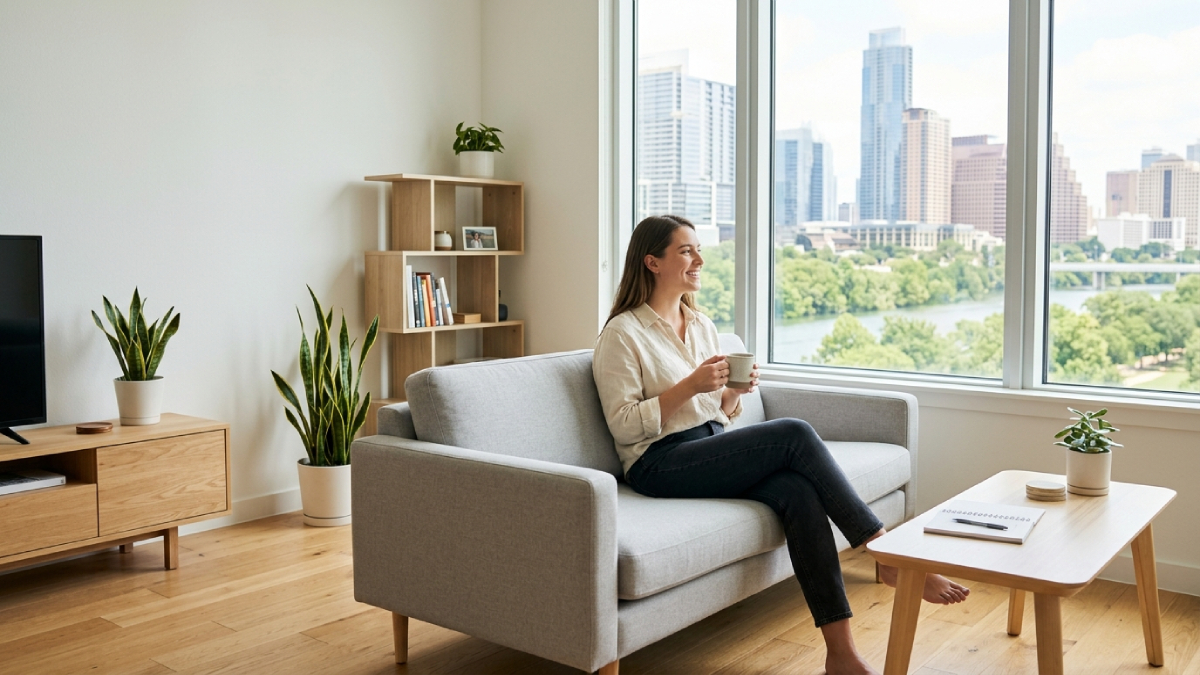
Minimalist living in Austin Texas isn’t just a Pinterest aesthetic anymore. For a growing number of renters, students, and young professionals in this city, it’s becoming a genuine survival strategy — and honestly, a quiet revolution.
Austin in 2026 is a city of extremes. World-class breakfast tacos. Live music every night of the week. Incredible culture, outdoor trails, and a tech scene that keeps exploding. But also: rents that have climbed so fast it feels like the city is playing a prank on you. Subscriptions you forgot you signed up for. A closet full of stuff that somehow still feels like “not enough.”
If you’ve been feeling the weight of it — the financial anxiety, the decision fatigue, the low-grade burnout from owning too much and spending too fast — you’re not alone. And minimalism, done right for Austin life, might be exactly what you need.
This isn’t about living with one mug and a meditation cushion. It’s about intentionally cutting what drains you so you can actually enjoy what Austin is best at.
What Minimalism Actually Means for Austin Life
Let’s clear something up: minimalism isn’t about deprivation. It’s not about living in a beige apartment with no personality or turning down Rainey Street happy hours forever.
In the Austin context, simple living means making deliberate choices about where your money, time, and energy go — so the city’s real pleasures don’t get buried under debt and clutter.
Think about it. Austin has free hiking at Barton Creek Greenbelt. Free music stages all over. Community events, parks, and swimming holes that cost nothing. The irony is that the most “Austin” experiences are already minimal. The expensive part is often the stuff we pile on top.
Minimalist living in Austin Texas is about removing that pile.
Why 2026 Is the Year More Austinites Are Choosing Less
The timing isn’t random. A few things converged that are pushing people toward intentional living in Austin in ways we haven’t seen before.
Rent kept climbing. The average one-bedroom in Austin now runs anywhere from $1,400 to $2,000+ depending on the neighborhood. That’s a huge chunk of a young professional’s paycheck — and it’s forcing real conversations about lifestyle design.
Digital burnout hit differently. After years of remote work, infinite scroll, and notification overload, people are genuinely exhausted. Minimalism isn’t just about physical stuff anymore. Decluttering your digital life — your apps, your subscriptions, your screen time — is now just as urgent.
The “experience economy” is winning. Austin’s culture is experiential by nature: the food, the festivals, the outdoor spaces. More people are realizing they’d rather spend $40 on a great meal at Franklin Barbecue than own $200 worth of kitchen gadgets they never use.
Low cost lifestyle in Austin is becoming not just smart — it’s becoming cool.
The Real Financial Case for Going Minimalist in Austin
Here’s where it gets concrete. Let’s talk about what a frugal minimalist in Austin can actually save.
Housing: The Biggest Lever
If you’re renting a 1-bedroom in South Congress versus sharing a 2-bedroom near Rundberg or Mueller, the difference can be $600–$900 per month. That’s not nothing. That’s a trip to Japan or four months of groceries.
A minimalist apartment in Austin doesn’t have to mean a tiny space. It means choosing a space that fits your actual life — not the life you imagine needing for guests three times a year.
One Austin renter I spoke to gave up her 950 sq ft solo apartment for a 560 sq ft studio near St. Elmo. She said: “I panicked at first. Then I realized I used maybe 60% of my old place anyway. Now I spend the savings on actual experiences.”
Subscriptions Are Quietly Bleeding You Out
The average American spends around $200–$300 a month on subscriptions. In Austin, where tech-savvy young professionals stack them up like pancakes — streaming, fitness apps, meal kits, cloud storage — it can go higher.
A simple audit takes 20 minutes. Check your bank statement for the last 60 days. Highlight every recurring charge. Then ask: Did I actually use this enough to justify it?
Cutting four unused subscriptions can free up $50–$80 per month. That’s over $900 a year.
Cars vs. The Austin Grid
Austin is improving its transit options, but many areas still make car ownership feel mandatory. Still, if you’re in Central Austin, East Austin, or near major corridors — the math on owning a second car often doesn’t hold up.
Decluttering your transportation costs (insurance, parking, gas, maintenance) can save $300–$500 per month for the right person. Apps like Bird, Lime, and expanding Metro rail lines are making this more viable every year.
How to Start Minimalist Living in Austin: A Practical 5-Step Guide
You don’t need to go full Marie Kondo on day one. Here’s a realistic path.
Step 1: Do the “One Month Snapshot”
Before you throw anything out or cancel anything — just observe for 30 days. Track what you buy. Track what you use. Note what you reach for daily versus what’s just there.
This step alone creates clarity that no YouTube minimalism video can give you. Your version of simple living in Austin will look different from someone else’s.
Step 2: Declutter in Layers, Not All at Once
Start with the obvious: stuff you haven’t touched in 12+ months. In Austin, this often means clothes for weather that never comes (heavy winter coats), duplicate kitchen items, and tech accessories for devices you no longer own.
Sell locally first. Austin has a thriving resale community. Facebook Marketplace, OfferUp, and local Buy Nothing groups are incredibly active here. One person’s stuff audit can turn into a few hundred dollars fast.
Step 3: Redesign Your Spending Around Austin’s Free Culture
This is the fun part. Austin is one of the best cities in the country for low-cost lifestyle living if you know how to use it.
- Barton Springs Pool: $5 admission or free for some hours
- Blanton Museum of Art: Free on Thursdays
- Barton Creek Greenbelt: Always free
- Long Center: Free outdoor events regularly
- Farmers markets at Republic Square: Free to browse, low-cost to buy fresh local food
The city is built for people who want to live well on less. Most people just don’t take advantage of it.
Step 4: Simplify Your Digital Life
Intentional living in Austin has a digital dimension that’s easy to overlook.
Unsubscribe from 10 email lists this week. Delete three apps you open out of habit, not purpose. Turn off non-essential notifications. Set screen time limits on your most distracting apps.
This sounds small. It isn’t. Digital clutter creates mental noise that spills into physical spending. When you’re bored and overstimulated, you buy things online at 11pm. When you’re calm and present, you don’t.
Step 5: Rebuild Intentionally
After the declutter comes the best part: only bringing back what genuinely fits the life you want.
For a lot of people in Austin, that means investing in: quality running gear (because the trails are amazing), a good coffee setup at home (because $7 lattes add up fast), and experiences over objects — concerts, weekend camping, weekend trips to the Texas Hill Country.
This is intentional living in Austin in practice. Not less for its own sake. Less of what doesn’t matter so there’s more room for what does.
Minimalist Apartment Living in Austin: Making Small Spaces Feel Big
If you’re in a smaller minimalist apartment in Austin, space optimization matters.
A few things that actually work:
- Vertical storage on empty walls keeps floors clear and makes rooms feel larger
- Multi-use furniture (ottomans with storage, fold-down desks) is worth the investment in small apartments
- One in, one out rule: Every new item you bring in means one leaves. Applies to clothes, kitchen tools, and random stuff you pick up at the Domain.
- Natural light over overhead lighting: Keeps spaces feeling open without buying new fixtures
The psychological effect of a clean, sparse space in a city as stimulating as Austin is genuinely underrated. Coming home to an uncluttered apartment after a loud, busy day is its own reward.
The Emotional Payoff Nobody Talks About
Here’s the honest truth about why people who commit to minimalism in Austin Texas keep doing it.
It’s not the money, though that’s real. It’s the feeling.
Less stuff means less decision fatigue every morning. Less financial anxiety because your fixed costs are manageable. Less FOMO because you’ve consciously chosen your life rather than defaulted into it.
There’s something specific to Austin about this, too. This city has a well-earned reputation for authenticity — “Keep Austin Weird” isn’t just a bumper sticker. And minimalism, at its core, is about authenticity. It’s about refusing to let marketing and social pressure define your life.
The person who wakes up in their clean, affordable studio, brews their own coffee, bikes to work along the Lady Bird Lake trail, and knows exactly what they’re working toward? That person isn’t missing out. That person is winning Austin.
Declutter, Save Money, and Actually Live in Austin
Decluttering to save money in Austin isn’t a sacrifice. It’s a reframe.
You’re not giving up the life Austin offers. You’re giving up the expensive fog around it so you can see the good stuff clearly.
The live music will still be there. The tacos will still slap. The Greenbelt will still be gorgeous in October. You’ll just be showing up to all of it with less financial stress, more physical space, and a clearer head.
That’s the version of Austin worth staying for.
❓ FAQ: Minimalist Living in Austin Texas
Q: Can I really live minimally in Austin without missing out on the city’s culture?
Absolutely. The best parts of Austin’s culture — the music, the outdoor spaces, the food scene, the creative community — are accessible without spending a lot. Minimalism actually increases your ability to enjoy Austin by reducing the financial pressure that makes experiences feel stressful.
Q: What’s the best neighborhood in Austin for a minimalist, low-cost lifestyle?
Areas like East Austin, North Loop, and parts of South Austin still offer relative affordability compared to the Domain or Westlake. Proximity to trails, transit, and walkable amenities means you can cut transportation costs significantly. Mueller and North Loop are especially good for people who want to own less and use public space more.
Q: Is minimalism realistic for families or people with kids in Austin?
Yes, though it looks different. Minimalism for families often focuses on experiences over toys, buying secondhand, using Austin’s parks and free family events, and avoiding the “activity arms race” that can drain family budgets. Many Austin families find that fewer scheduled activities and less stuff creates more quality time together.
This guide was written with 2026 Austin residents in mind — renters, students, young professionals, and anyone feeling the squeeze of an expensive, stimulating city. The goal isn’t a perfect minimal life. It’s a more intentional one.