




If you’re searching for how to budget rent food Austin-style in 2026, you’re in the right place — because the numbers can feel genuinely overwhelming the first time you see them.
Maybe you’re moving here for a job. Maybe you’re a student figuring out if Austin is even doable on your income. Or maybe you’ve been here a year and still feel like your paycheck vanishes before the 15th.
You’re not imagining it. Austin’s rent and living costs have climbed sharply, and 2026 has not been kind to renters. But it is manageable — if you know what you’re actually dealing with.
This is a real, no-fluff cost of living Austin 2026 breakdown: actual numbers, honest context, and practical steps you can take today. Already know the basics? Jump to our step-by-step budgeting guide or read about affordable apartments in Austin.
Let’s get into it.
Why budget rent food Austin living costs keep rising in 2026
Five years ago Austin had a reputation as a cheaper alternative to San Francisco or New York. That reputation is outdated.
The tech boom, remote-work migration, and rapid population growth transformed Austin into one of the fastest-growing — and fastest-inflating — cities in the country. Between 2022 and 2025, rent in some zip codes rose more than 30%. Supply eventually caught up in certain areas, which softened things slightly, but don’t let that fool you.
In 2026, Austin still ranks as one of the more expensive mid-tier US cities, particularly for renters earning under $70,000 a year. Getting a clear expense breakdown Austin residents can actually use is the first step to not being blindsided.
Full Austin monthly expense breakdown (2026)
Here’s a realistic monthly snapshot for a single person renting in Austin:
| Expense | Estimated Monthly Cost |
|---|---|
| Rent (1BR, mid-range) | $1,350 – $1,800 |
| Groceries | $280 – $400 |
| Utilities (electric, water, gas) | $120 – $200 |
| Internet | $50 – $80 |
| Transportation | $100 – $250 |
| Dining out / takeout | $150 – $300 |
| Health / personal care | $60 – $120 |
| Entertainment / misc | $80 – $150 |
| Total (estimated) | $2,190 – $3,300 |
That’s a wide range — intentionally. Your actual number depends on your neighborhood, lifestyle, and the choices you make. Let’s break each one down.
Also see: how Texas’s no-state-income-tax rule affects your take-home pay.
budget rent Austin: what you’re actually looking at in 2026


Rent is the biggest variable when you try to budget rent food Austin-style, so let’s be direct.
Rent ranges in Austin right now:
- Studio apartments: $1,050 – $1,350/month (East Austin, South Congress, further suburbs)
- 1-bedroom apartments: $1,300 – $1,800/month depending on location
- 2-bedroom split with a roommate: $800 – $1,100/month per person — this is where the real savings live
If you’re a young professional or student trying to make Austin work, getting a roommate is the single biggest lever you can pull. A two-bedroom split two ways beats a solo studio almost every time, financially.
Neighborhoods with more affordable rent in Austin:
- Pflugerville / Round Rock – Suburban but noticeably cheaper. Great if you have a car.
- North Lamar corridor – More central, slightly less trendy than downtown, but well-connected.
- East Oltorf / Riverside – Not the flashiest zip code, but solid value and close to downtown.
- Cedar Park / Leander – Further out, but rents run 15–20% lower than central Austin on average.
Watch for this: many newer luxury complexes advertise “affordable” units but add $80–150/month in amenity fees, mandatory valet trash, or overpriced in-house renters insurance. Read your lease before you sign.
food budget Austin: the real monthly groceries cost
If you cook at home regularly, $280–$350/month is achievable for a single person in Austin. Shop at Whole Foods daily and that number climbs fast.
Austin’s grocery ecosystem, ranked for budget renters:
- H-E-B — the gold standard. Prices are competitive, produce is solid, store brands are excellent. If you’re not shopping here regularly, you’re overspending on groceries.
- Walmart Supercenter — best for pantry staples and bulk items.
- Aldi — expanding in Austin; excellent for budget grocery shopping.
- Whole Foods / Central Market — amazing stores, but 30–40% more expensive on basics. Reserve for specialty items only.
A realistic weekly H-E-B run — eggs, chicken thighs, rice, pasta, fresh vegetables, fruit, bread, dairy, snacks — lands around $60–$80/week, or roughly $280–$320/month.
Real example: Maya, a 26-year-old UX designer who moved to Austin in late 2025, cut her grocery bill from $480 to $310/month just by switching from Whole Foods to H-E-B and prepping meals on Sunday nights. Same food quality. $170 back in her pocket every month.
If you’re a student, check whether your campus has a food pantry. UT Austin and other institutions have expanded food assistance programs — no shame in using them.
Utility cost Austin: the number most people underestimate
Here’s where a lot of new Austin residents get blindsided.
Texas summers are brutal. Your electric bill in July and August can easily hit $180–$220/month for a standard one-bedroom — sometimes more in older, poorly insulated units. This is not an exaggeration.
Monthly utility cost Austin breakdown (averaged across the year):
- Electricity: $80–$180 (spikes hard in summer)
- Water/sewer (if not included in rent): $30–$55
- Gas (low usage in Austin’s climate): $15–$30
- Internet: $50–$80 (AT&T and Google Fiber serve many Austin zip codes)
Total average: $130–$200/month — budget toward $200 to avoid summer bill shock.
Ways to cut your electric bill:
- Set your thermostat to 76–78°F when home, 80°F when out — saves roughly $40/month
- Run ceiling fans; they make a room feel 4–6°F cooler at a fraction of the AC cost
- Ask your landlord whether the unit has been weatherproofed — gaps in windows bleed cold air fast
- Avoid dishwasher and laundry during peak hours (3–7 PM on weekdays)
Transportation and monthly bills Austin renters pay
Austin is a car city. The public transit system (CapMetro) has improved with new rail and bus lines, but it still doesn’t cover the metro the way a car does.
If you have a car:
- Gas: ~$80–$120/month
- Insurance: $100–$160/month (Texas rates run above the national average)
- Parking: $0 in most neighborhoods; $100–$200/month downtown
If you don’t have a car:
- CapMetro monthly pass: ~$41 (reduced rates for students)
- Rideshare supplement (Uber/Lyft): $50–$100/month
- Biking is viable in central Austin with the expanding trail network
Best move: Choose an apartment within 2 miles of your workplace or on a major transit corridor. That one decision can save you $150–$300/month.
Other monthly bills Austin renters commonly forget to budget:
- Renters insurance: $12–$25/month — compare rates at Lemonade before accepting whatever your landlord recommends
- Phone bill: $30–$80/month — Mint Mobile and Visible undercut the major carriers significantly
- Streaming subscriptions: $20–$60/month — audit these quarterly, you’re probably paying for something you forgot about
- Gym / fitness: $0 (Barton Springs is free) to $50–$80/month for a membership
Dining out in Austin: enjoy the food scene without blowing the budget
Austin has an incredible food scene. Breakfast tacos alone could justify living here. The problem is that eating out adds up faster than almost anywhere.
- Casual taco spot or sit-down: $12–$20 per meal
- Mid-range restaurant: $25–$45 per person
- Daily coffee shop habit: $5–$7/visit = $150–$210/month
The “social eating” trap is real. Austin’s brunch culture, food truck scene, and live music venues that serve food make it easy to spend $300–$400/month eating out without noticing.
How to enjoy it affordably:
- Set a weekly dining-out cap ($60–$80 is reasonable)
- Lean on happy hours — Austin’s are excellent, often 3–6 PM with half-price food
- Food trucks frequently deliver the same quality as sit-down restaurants at 30–40% less
- Cook most meals at home; give yourself 2–3 guilt-free nights out per week
How to budget rent food Austin step-by-step in 2026

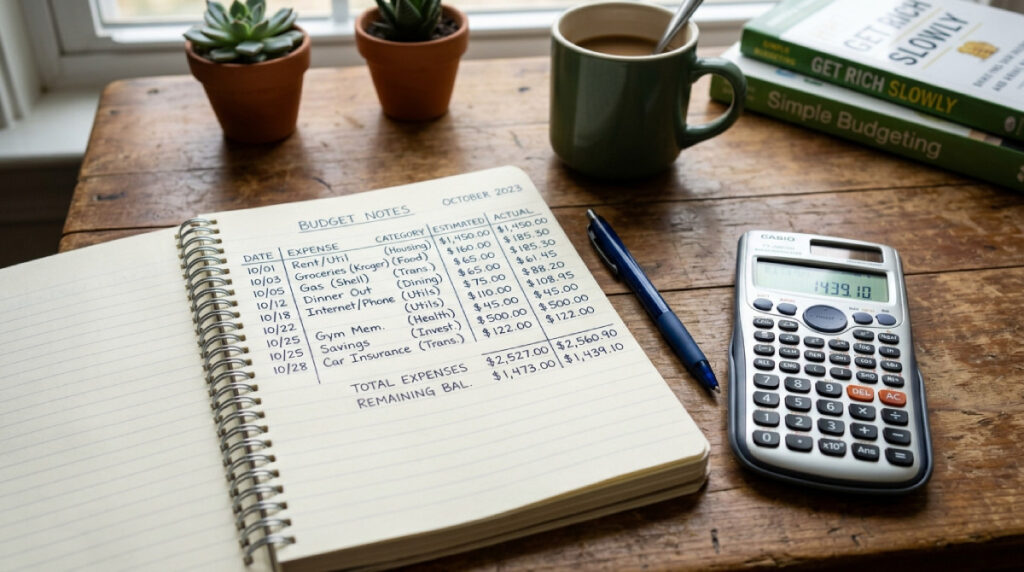
Here’s a practical, beginner-friendly framework for rent budgeting in Austin — not a spreadsheet, a mindset.
Step 1: Start with your real take-home income
Not your gross salary. What actually hits your bank account after federal taxes and FICA. Texas has no state income tax, which is a genuine advantage — factor that in.
Step 2: Assign rent first
The standard rule is rent ≤ 30% of take-home. In Austin in 2026, many people stretch to 33–35% — that’s okay, but make it a conscious decision, not an accident.
Step 3: Map your fixed costs
Utilities + internet + phone + renters insurance = your monthly “floor.” These barely change. Know the exact number.
Step 4: Set a grocery budget and default to H-E-B
$300/month is realistic for one person. Go with a list. Don’t shop hungry.
Step 5: Build in a real fun budget — and protect it
People who budget with zero flexibility always fail. Give yourself $100–$200/month for dining, entertainment, and spontaneous spending. Use it without guilt. Don’t exceed it.
Step 6: Automate savings on payday
Even $100–$200/month into a high-yield savings account (HYSA) — before you see it, before you spend it. Austin’s unexpected costs (a blown tire, an AC repair, a security deposit on your next place) will come. Be ready.
For more on building a savings habit, see our guide: best high-yield savings accounts for renters in 2026.
Is affordable living in Austin still possible in 2026?
Honestly? For a lot of people, yes.
The job market — especially in tech, healthcare, and creative industries — is still strong. The cultural scene, outdoor lifestyle (Barton Springs, Zilker Park, the greenbelt), and year-round events make Austin genuinely livable. And Texas’s no-state-income-tax rule meaningfully increases your take-home pay compared to California or New York.
But Austin has stopped being a “cheap city.” It’s mid-to-premium-tier now, and your budget has to reflect that reality. The good news: affordable living Austin is still doable if you’re intentional about the big decisions — especially housing.
- Earning $55,000–$75,000/year? You can live comfortably here with intention.
- Under $45,000? Tight — but possible with a roommate, public transit, and disciplined grocery habits.
The people who thrive here on a budget go in with their eyes open, make deliberate housing decisions, and resist the urge to keep up in one of the trendiest cities in America.
Frequently asked questions
What is a realistic monthly budget for a single person in Austin in 2026?
Budget $2,200–$2,800/month for a modest but comfortable lifestyle — rent, food, utilities, transport, and some social spending. This assumes a roommate or a modest apartment outside the downtown core.
Is $50,000/year enough to live in Austin?
It’s possible with careful planning. At $50k, take-home is roughly $3,500–$3,800/month. After rent ($1,100–$1,400 with a roommate), you’ll have $2,100–$2,400 for everything else. Doable — but no room for lifestyle inflation.
Which Austin neighborhoods are best when you budget rent food Austin on a tight income?
Pflugerville, Round Rock, Leander, and North Austin offer the best rent-to-value ratios. East Riverside is budget-friendly too — just research the specific block before committing.
Final thought
Austin can feel overwhelming when you first stare down the numbers. But the people who stress most about the cost of living here are usually the ones who never sat down and mapped it out.
You now have the map.
Rent is your biggest decision — make it deliberately. H-E-B will rescue your food budget. Utilities will blindside you in August if you’re not prepared. And a little structure each month means you can actually enjoy everything Austin has to offer without the financial dread creeping in on a Tuesday night.
This city is expensive. But it’s not impossible. Know your numbers, own your choices, and build a budget rent food Austin plan that works for your real life — not the Instagram version of Austin life.


