

The 50 30 20 budget rule Austin Texas residents keep Googling — and then immediately feeling confused about — deserves a brutally honest rewrite for 2026.
You open your bank app on a Tuesday night, stare at your balance, and feel that familiar knot tighten in your stomach.
You’re not broke. You have a job. You’re making decent money. But somehow — somehow — the math never adds up. The rent went up again. Groceries cost more. And every budgeting article you find online talks about numbers that feel like they belong in a different city entirely.
If you’re living in Austin, Texas in 2026, you already know: the old rules of budgeting don’t quite fit anymore.
That’s exactly why we need to talk about the 50 30 20 budget rule Austin Texas style — not the generic textbook version, but a version that actually makes sense given what rent, groceries, and gas cost here right now.
Let’s break it all down, from scratch, in plain English.
What Is the 50 30 20 Budget Rule? (Austin Texas Beginner’s Guide)
The 50 30 20 budget rule Austin Texas beginners ask about most is actually one of the simplest frameworks in personal finance — and for good reason. It’s flexible, and doesn’t require a spreadsheet degree to understand.
Here’s how it works:
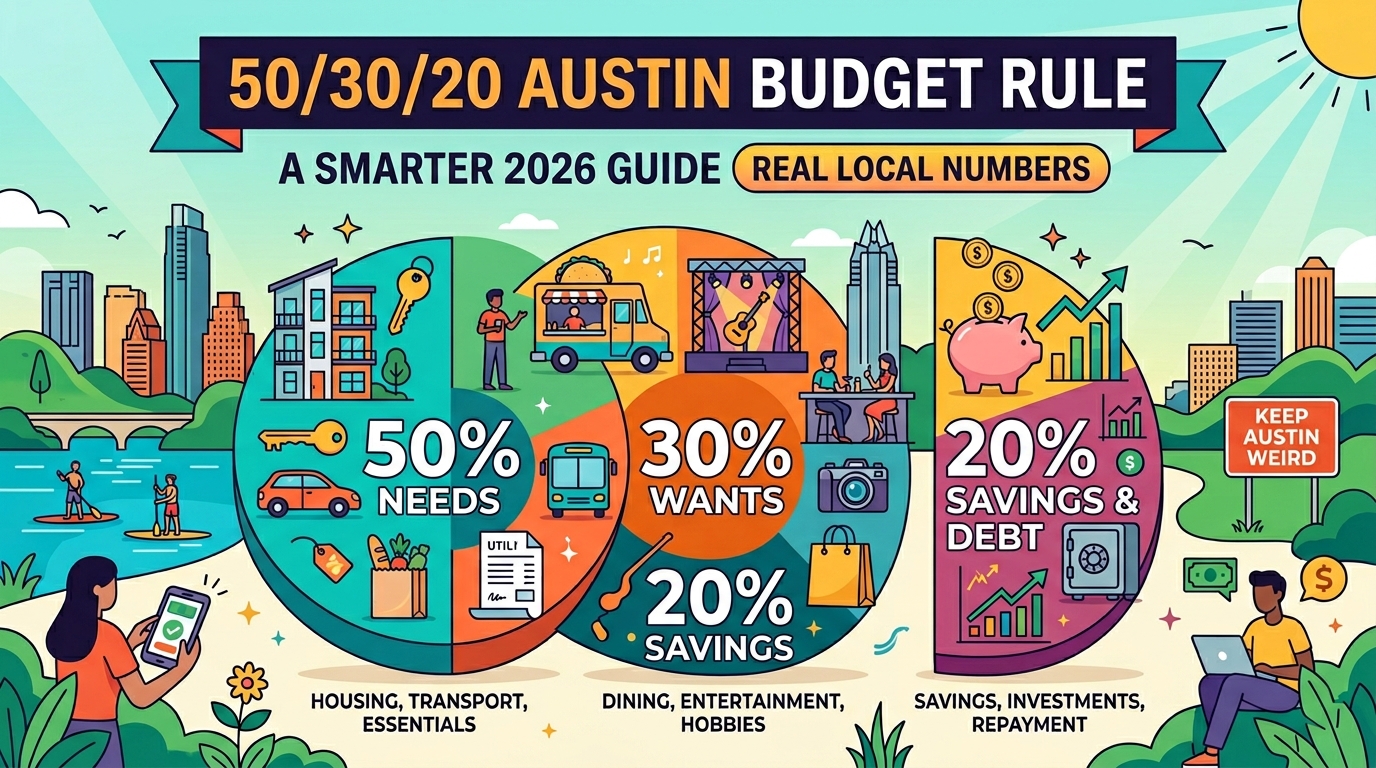
- 50% of your after-tax income goes to needs — rent, utilities, groceries, transportation, minimum debt payments
- 30% of your after-tax income goes to wants — dining out, subscriptions, hobbies, entertainment
- 20% of your after-tax income goes to savings and debt payoff — emergency fund, retirement, extra debt payments
It was popularized by Senator Elizabeth Warren in her book All Your Worth and has since become the go-to starting point for anyone learning how to budget.
The appeal? You don’t have to track every single dollar. You just need to know which category your spending falls into.
But here’s the problem nobody talks about enough: This rule was designed when housing costs were very different. And in Austin, Texas in 2026, your “needs” category is quietly eating everything else alive.
Austin’s Cost of Living in 2026: Why the 50 30 20 Budget Rule Austin Texas Residents Use Needs Adjusting
Austin has changed dramatically over the last few years. What was once considered an affordable alternative to California has become one of the pricier cities in the South.
Let’s look at some real numbers:
- Average 1-bedroom apartment rent in Austin: $1,400–$1,800/month (and that’s not even in the trendy neighborhoods)
- Average monthly groceries for one person: $350–$450
- Car insurance in Texas: Among the highest in the nation, often $150–$250/month
- Utilities (electric, internet, water): $180–$280/month in summer, thanks to brutal Texas heat
- Gas: Fluctuating but consistently higher than national averages
Now do the math. If you’re a young professional bringing home $4,000/month after taxes — which isn’t far off for many entry-level roles in tech, healthcare, or education here — your “needs” category alone could easily hit $2,500 to $2,800.
That’s 62 to 70 percent of your income. Just for the basics.
You see the problem.
A Real-Life 50 30 20 Rule Example Austin Style
Let’s walk through this with a real scenario.
Meet Jordan, 27, a marketing coordinator at a tech startup in Austin making $58,000/year. After Texas state income tax (which, good news — there isn’t one) and federal taxes, Jordan takes home roughly $4,100/month.
Here’s what the classic 50/30/20 rule says Jordan’s budget should look like:
| Category | Percentage | Monthly Amount |
|---|---|---|
| Needs | 50% | $2,050 |
| Wants | 30% | $1,230 |
| Savings | 20% | $820 |
Sounds reasonable, right? Now let’s see what Jordan’s life actually costs:
Needs:
- Rent (1BR in South Austin): $1,550
- Electric + water: $200
- Internet: $60
- Groceries: $380
- Car insurance: $185
- Gas: $120
- Phone bill: $75
- Total Needs: $2,570
That’s already $520 over the 50% target — and Jordan hasn’t even had one meal out yet.
This is the reality for a huge portion of Austin residents in 2026. The 50 30 20 budget rule Austin Texas professionals try to follow isn’t broken in theory. It’s just built for a cost of living that doesn’t exist here anymore.
So what do you do?
How to Use the 50 30 20 Budget Rule Austin Texas Style (The Adjusted Version)
Here’s the honest truth: you may need to flex the percentages — and that’s perfectly okay.
The goal of the 50/30/20 rule was never really about those exact numbers. It was about creating balance between surviving today, enjoying today, and preparing for tomorrow. The percentages are a guideline, not a law.
For Austin residents in 2026, a more realistic version might look like 60/20/20 or even 65/15/20 depending on your income and housing situation.
Here’s how to make it work without giving up on the method entirely:
Step 1: Calculate Your Real Take-Home Pay
Don’t budget based on your salary. Budget based on what actually hits your bank account after federal taxes, health insurance premiums, and any other pre-tax deductions.
If you’re unsure, look at your last two or three pay stubs and take the average.
Step 2: List Every Fixed Expense First
Before you allocate anything to “wants” or “savings,” write down every expense that doesn’t change month to month:
- Rent
- Car payment (if applicable)
- Insurance (car, renters, health)
- Internet
- Phone
These are your locked-in costs. You can’t negotiate them away easily, at least not in the short term.
Step 3: Estimate Your Variable Needs
Now add the stuff that fluctuates but is still a true need:
- Groceries (be honest — not your fantasy grocery bill, your real one)
- Gas or transit costs
- Utilities
A good trick: look at the last 3 months of bank statements and average these out. Most people significantly underestimate their grocery spending.
Step 4: See What Percentage Your “Needs” Actually Are
Take your total needs and divide by your monthly take-home pay.
If it’s above 60%, you’re not failing at budgeting. You’re living in a city with high costs. That distinction matters a lot for your mental health and your strategy.
Step 5: Adjust the Other Categories — But Don’t Kill Savings Entirely
This is where most people make a critical mistake. When needs eat too much of the budget, they slash savings entirely instead of trimming wants.
Don’t do that.
Even if you can only save 10% right now, that habit matters enormously over time. Keep something going toward savings — even if it’s just $150/month into a high-yield savings account.
For wants, get ruthless. Not punishing — just ruthless. A $17 streaming service you haven’t opened in three months is a “want” masquerading as a habit.
Budget Percentages Austin Residents Can Actually Use
Here’s a more realistic version of the 50/30/20 rule built for Austin’s 2026 cost of living:
If you earn $3,500–$4,500/month take-home:
| Category | Adjusted % | Monthly Amount (at $4,000) |
|---|---|---|
| Needs | 60–65% | $2,400–$2,600 |
| Wants | 15–20% | $600–$800 |
| Savings | 15–20% | $600–$800 |
If you earn $5,000–$7,000/month take-home:
| Category | Adjusted % | Monthly Amount (at $6,000) |
|---|---|---|
| Needs | 50–55% | $3,000–$3,300 |
| Wants | 20–25% | $1,200–$1,500 |
| Savings | 20–25% | $1,200–$1,500 |
At higher income levels, the classic 50/30/20 becomes more achievable — simply because fixed costs like rent don’t scale proportionally with income.
This is a crucial insight: the lower your income, the harder the original rule is to hit. That’s not a character flaw. It’s math.
The One Thing That Changes Everything: Housing Decisions
If there’s one lever Austin residents have the most control over, it’s housing — and most people underestimate how dramatically it affects the entire budget.
Consider:
- Getting a roommate in a 2BR apartment can drop your rent from $1,600 to $900, freeing up $700/month instantly
- Moving to a suburb like Pflugerville, Cedar Park, or Kyle can cut rent by $300–$500/month (though gas costs increase slightly)
- Negotiating your lease renewal — Austin’s rental market has softened slightly in 2026 compared to its 2022–2023 peak, meaning there’s more room to negotiate than many renters realize
If your needs category is blowing past 60%, housing is almost always the place to look first.
Monthly Budget Austin Checklist: Getting Started Today
Not sure where to begin? Here’s a simple first-week action plan:
Day 1: Pull up 3 months of bank statements. Don’t judge. Just look.
Day 2: Categorize every transaction into Needs, Wants, or Savings. Use a simple spreadsheet or a free app like YNAB or Monarch Money.
Day 3: Calculate what percentage each category actually represents.
Day 4: Identify one “want” you can cut immediately without feeling miserable. (Be selective — the goal isn’t misery, it’s awareness.)
Day 5: Set up one automatic transfer to savings, even if it’s just $50 or $100. Automation is the secret weapon.
Week 2 and beyond: Revisit monthly. Adjust as life changes.
The budget you’ll actually stick to is the one that reflects your real life — not someone else’s ideal version of it.
Is the 50/30/20 Rule Right for Austin Beginners?
For most beginners, yes — with modifications.
The biggest value of the 50/30/20 rule isn’t the exact percentages. It’s that it gives you a framework, something to measure against. Without any framework, spending is invisible. With one, patterns emerge fast.
Even if you can’t hit the “official” numbers right now, knowing you’re spending 65% on needs instead of 50% is useful information. It tells you that income growth — through raises, side income, or career moves — will have a bigger impact than extreme frugality in your current situation.
That’s empowering, not defeating.
The goal is progress, not perfection. Getting from zero budgeting awareness to even a rough 60/20/20 split is a massive, meaningful win.
FAQ: 50/30/20 Budget Rule Austin Texas
Q: My rent alone is more than 50% of my income in Austin. Am I doing something wrong?
Not necessarily. Austin’s rental market is expensive relative to median incomes, especially for entry-level earners. You’re not failing — you’re facing a structural affordability challenge that many Austin residents deal with. The goal is to adjust your percentages realistically and find ways to increase income or reduce the biggest fixed costs over time.
Q: Should I still save 20% even if my budget is tight?
Start with whatever you can sustain. Even 5–10% saved consistently beats saving 20% for two months and then stopping. Build the habit first, then increase the amount as your income grows or expenses drop.
Q: What’s the difference between “needs” and “wants” in the 50/30/20 rule?
A “need” is something you must have to function — housing, food, basic transportation, utilities, minimum debt payments. A “want” is something that adds enjoyment or convenience but isn’t essential. The line blurs sometimes (like a gym membership that keeps you healthy vs. a fun hobby expense), and that’s okay. Make a judgment call and stay consistent.
The Bottom Line
The 50 30 20 budget rule Austin Texas residents can rely on is one of the most useful frameworks a beginner can use — but it needs to be treated as a starting point, not a strict rule.
In 2026, with Austin’s rising costs of living, many residents will find that a 60/20/20 or even 65/15/20 split is more realistic, at least initially. That’s not failure. That’s honest budgeting.
What matters most is that you have a plan, you know where your money is going, and you’re intentionally working toward a future that feels more stable and more free.
Start today. Not perfectly. Just start.
Even one honest look at your bank account is a better place to be than where most people are — which is eyes closed, hoping it somehow works out.
It works out when you make it work. And now you know how.
Looking to go deeper? Check out resources like NerdWallet’s budgeting guide or the Consumer Financial Protection Bureau’s budgeting tools for additional frameworks and worksheets.